

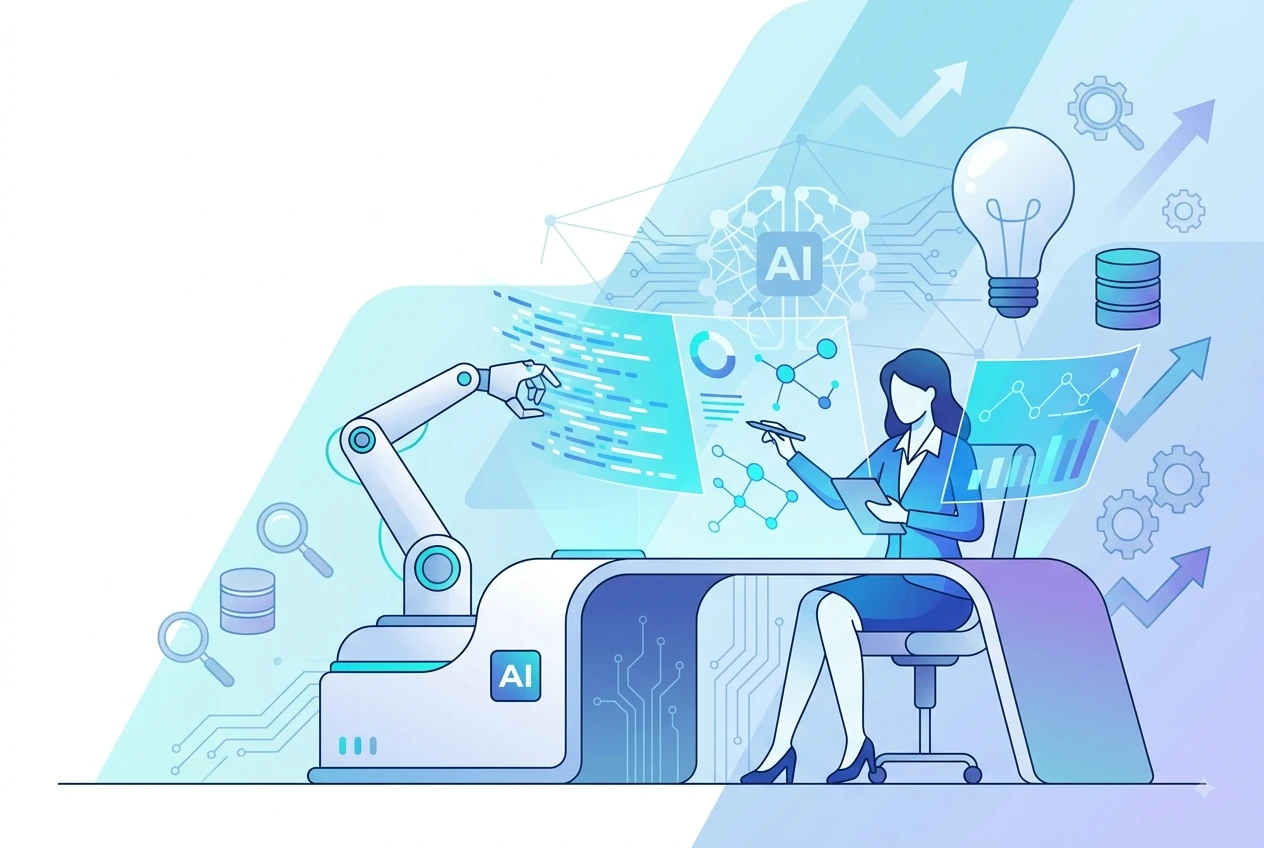
Data Analytics has changed a lot in the past ten years. Companies get a lot of data from their websites, mobile apps, business processes, IoT devices and social media sites. Even though old ways of analyzing data have helped companies make sense of this data, they need solutions because the data is getting bigger and more complicated.
Artificial Intelligence has already made a difference in data analytics with machine learning, predictive modeling and generative AI.
The latest thing in data analytics is AI agents. Software programs that can do analytics tasks make decisions and do things on their own without people. This is a step forward from regular analytics tools to digital assistants that can help analysts manage data all the time.
What are AI Agents?
AI agents are software programs that can look at information, analyse data, make decisions and do things to achieve specific goals. Unlike software programs that just follow instructions. AI agents can adapt to changes, learn from experience and decide what to do on their own.
In data analytics, an AI agent is like a helper that watches datasets, finds mistakes, makes reports, gives recommendations and automates tasks. Instead of waiting for analysts to start each task, an AI agent finds areas for improvement and suggests what to do.
The old way of doing analytics involves manual steps like collecting data, cleaning data, analysing data, making models, creating dashboards and understanding results, etc. Even though today’s analytics tools make these tasks easier. People still need to put in effort to code and prepare datasets.
An AI agent makes analytics more automatic because it helps with all these tasks. It constantly watches data, finds important changes, suggests analysis methods, generates code, and concludes on its own.
This change allows businesses to react faster to changes and gives analysts time to think strategically about doing repetitive technical tasks.
AI Agents in Data Analytics Process
Intelligent Data Gathering
A company gets data from sources like databases, cloud storage, APIs, business apps and IoT devices. AI agents can automate gathering and integrating data by finding sources scheduling updates, checking data and detecting mistakes before analyzing data.
This reduces delay and improves accuracy in analytics tasks.
Automated Data Cleaning
Preparing data for analytics usually takes time in an analytics project. Missing data, duplicates and inaccuracies can greatly affect analytics results.
AI agents make data preparation easier by doing tasks like:
Informed Exploratory Data Analysis
This step is about finding patterns and trends in data. AI agents do this quickly by generating statistics detecting correlations and suggesting visualizations.
There is no need to look at every variable because AI agents provide a summary of the important insights.
Predictive Analytics with AI Agents
Machine learning models need to be chosen, trained and optimized. AI agents help with each step of this process from selecting algorithms to evaluating performance.
AI agents can compare machine learning models and recommend which one is more relevant for the business task.
Automatic Report Generation
Presenting insights is as important as the analysis itself. With AI agents, it is possible to generate business reports, calculate performance metrics, prepare dashboards and interpret trends in plain language.
Development Assistance for Analytics
Data analytics projects rely heavily on programming languages like Python and SQL. Writing scripts for data processing, visualisation, and machine learning can be challenging.
AI-powered development assistants have become tools for data analysts and developers, providing code suggestions, explaining programming concepts and eliminating repetitive code.
One popular development assistant is GitHub Copilot, which’s an AI-based code-writing assistant that allows writing code efficiently. GitHub Copilot understands the project context and provides suggestions for Python functions, SQL queries, data manipulation, visualisation, and machine learning algorithms.
With GitHub Copilot, data analysts can get help with:
GitHub Copilot is not meant to replace skills but is a productivity tool that reduces repetitive coding.
Advantages of Using AI Agents in Data Analytics
There are advantages to using AI agents in data analytics including:
With AI agents, analysts can focus on developing strategies, understanding the business and innovating.
Problems and Ethics
While AI agents have advantages, their use requires careful planning and an ethical approach.
It is necessary to consider aspects like:
Knowledge is essential to properly assess insights provided by AI agents.
Future Prospects of AI Agents in Data Analytics
In the future, AI agents will become more autonomous. They will monitor business performance, investigate events, build predictive models, make reports and suggest strategies.
The integration of AI agents with cloud services, Business Intelligence and Large Language Models will create data analytics ecosystems that enable continuous decision-making in various industries.
AI agents will assist people in solving problems and will not replace data analysts. They will help people avoid tasks and focus on strategic thinking.
AI agents are the step in the evolution of data analytics. Their ability to collect and process data automatically build models and reports and assist in software development is changing the nature of data insight creation. Examples like GitHub Copilot show the potential of intelligence, in enhancing productivity by assisting programmers and analysts.
In the era of automation, people who can understand AI agents and use them effectively will be prepared for the future. Data analytics will become more efficient. AI agents will play a crucial role in this transformation.