

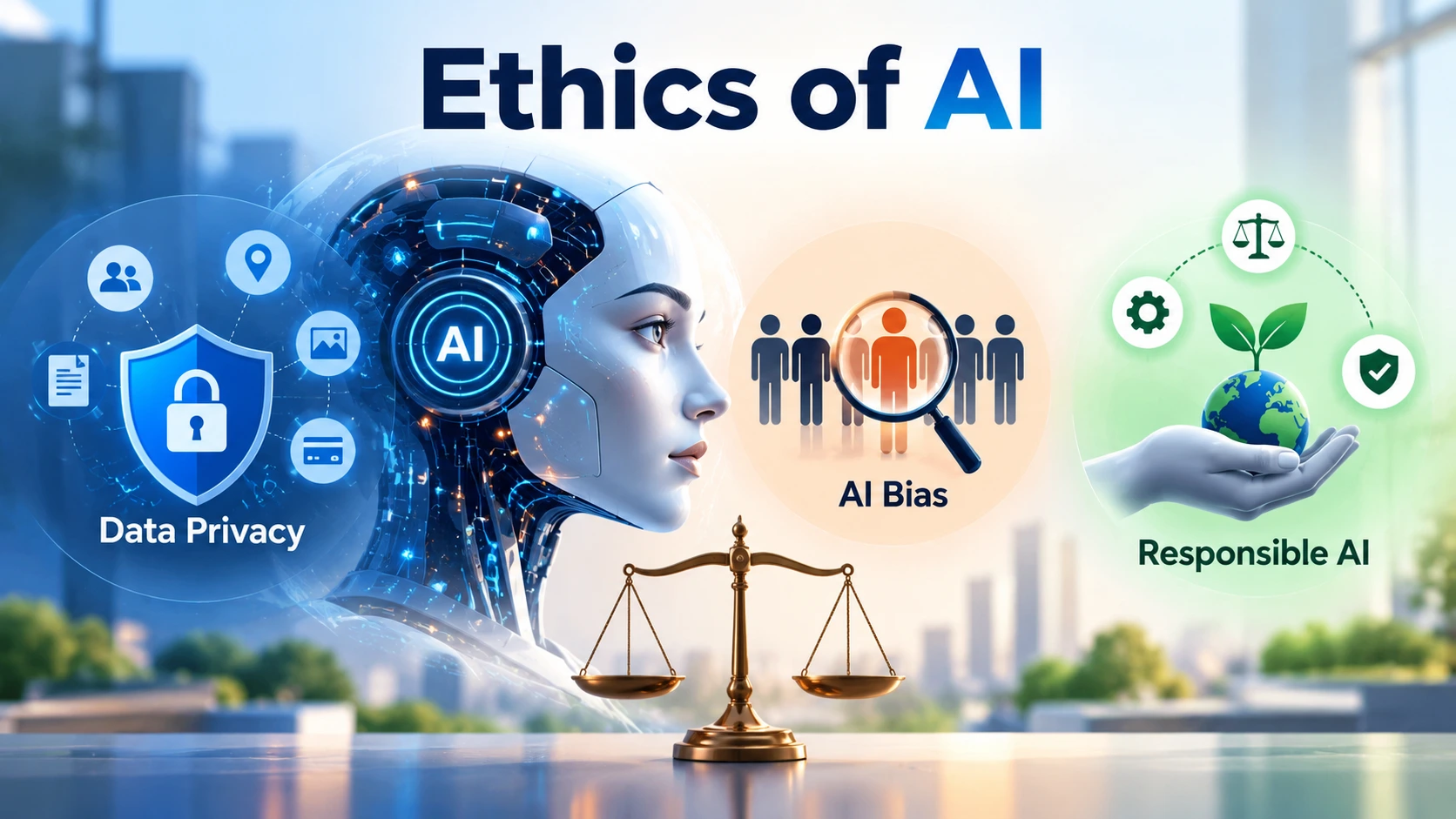
Artificial Intelligence is now an integral part of our daily lives. It recommends things to us, answers our queries, assists doctors in diagnosing some diseases, and even drives our vehicles. With the advancement of AI, several questions emerge: Is it ethical? Is it safe? Is our privacy maintained by it? This refers to AI ethics, which implies developing an ethical and responsible AI technology. There are three main concerns in this context – privacy, bias, and responsible AI.
1. Privacy of the Data: Whose Information It Is, anyway?
AI relies on data that include names, location, photos, browsing habits, finances, and many other things. And in case such information is not controlled properly, it might be disclosed to third parties and used without our consent.
For example, imagine the shopping application that analyses our habits in order to provide some recommendations. This sounds well, but in case the app collects much more information than it really needs to, our privacy becomes compromised.
The good news is that organizations can prevent any possible threats to the users. First, they can collect information when it is really needed. Second, they can ask our permission to collect such information. Third, the data should be stored in a safe way. And finally, access to certain information should be restricted. Only when someone knows that their privacy is protected can they trust the technology.
Protecting personal information is essential in the age of AI. Understanding the relationship between artificial intelligence and data privacy helps us explore how technology can advance while keeping our information safe.
2. Bias: Where AI Makes Mistakes with Certain Groups
In an ethics of AI context, AI bias occurs when a specific group of individuals is discriminated against by a machine, often because of its training data or design. This does not necessarily result from intentional wrongdoing by the machine but rather from biases present in the data or system design.
AI systems learn from examples. Therefore, if their training data contains discrimination, they may reproduce similar patterns. For example, an AI hiring system trained on past company decisions that disadvantaged certain groups may continue to show the same bias. Similarly, facial recognition software may perform differently across demographic groups.
This issue can be addressed by using diverse training data and regularly testing AI systems to ensure fair results. Human oversight is particularly important when AI makes decisions that affect people’s careers, rights, or lives.
3. “Responsible AI” Definition
This definition presupposes the design and use of technologies that have no negative effect on people or do not violate their rights, and some individual is responsible for any mistake. There are some distinctive features of responsible AI:
Fairness: The system should not discriminate without reasonable cause.
Transparency: People should be informed about the fact that AI technologies are used and their capabilities.
Accountability: Companies and individuals who design AI technologies are responsible for them.
Safety and reliability: AI systems can make mistakes and generate false information.
4. Why Do We Need Humans?
The rapidness of operations does not necessarily mean that all processes are carried out right. In such spheres as medicine, education, finance, and recruitment, there should still be room for humans.
For instance, an artificial intelligence could provide an indication of something wrong to the doctor; however, the human has to balance the algorithm’s advice and the experience of the patient. Humans can detect mistakes, understand the situation, and make proper decisions.
Conclusion
There is no denying that AI technologies are powerful tools with applications in various fields, including medicine, education, work, and daily life. However, the ethics of AI must be considered to ensure that these technologies are used responsibly, with a focus on privacy, fairness, security, and accountability.
With appropriate measures to protect personal data, minimize AI bias, and maintain human oversight, we can build trustworthy AI systems that benefit society while respecting individual rights.