

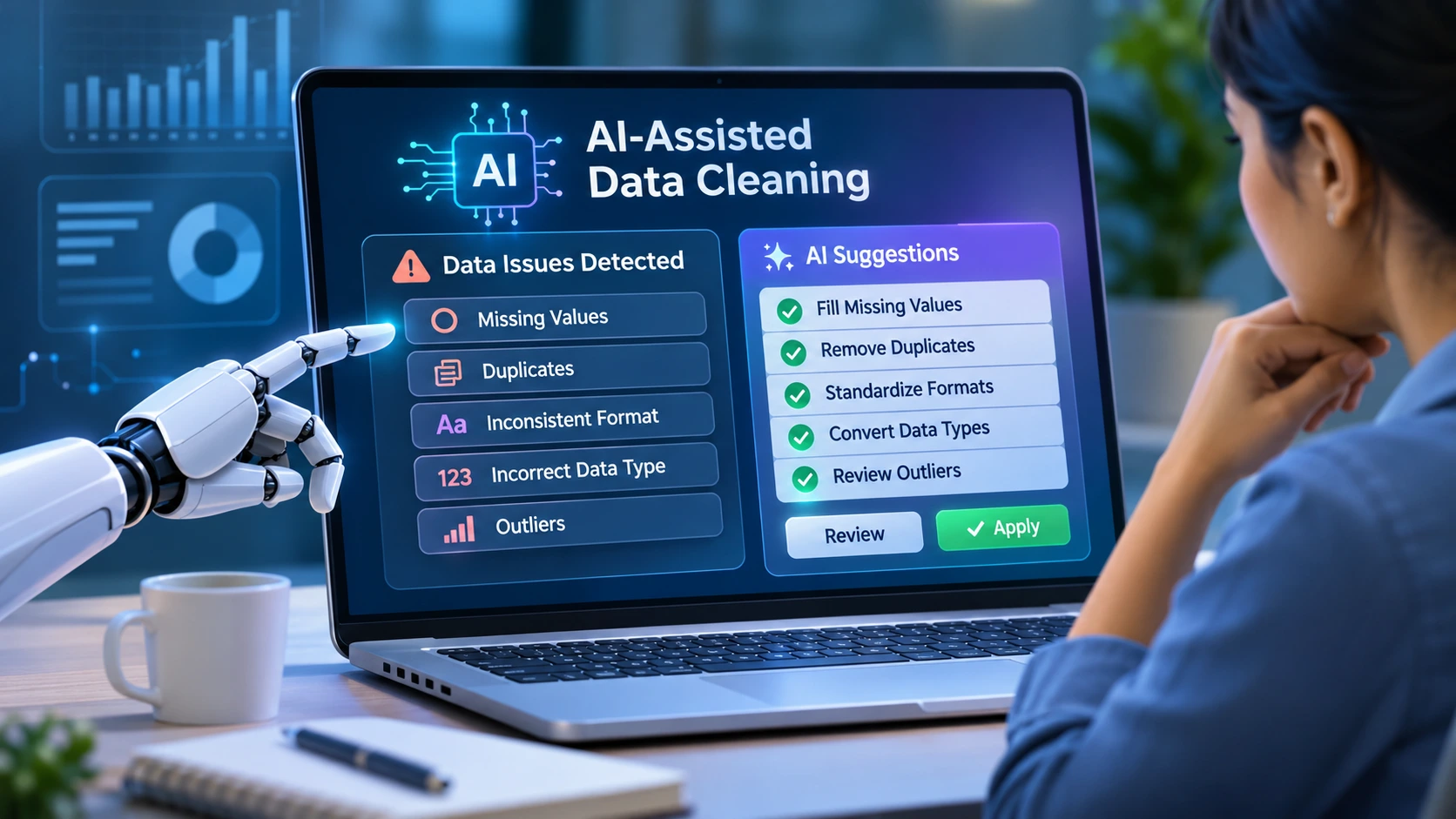
AI-assisted data cleaning is transforming one of the most tedious steps in data analytics. There are many issues that may appear in datasets, including missing values, duplicates, inconsistent formats, incorrect data types, and outliers. All these issues should be addressed before analysis, visualization, or making data-driven decisions.
As generative AI and AI-based analytics applications become increasingly popular, many of these tasks can now be automated. AI systems are capable of profiling the dataset, finding potential quality issues in it, suggesting transformations, and generating corresponding code to clean the data.
There arises an important question:
Are we able to trust the data transformations suggested or performed by AI?
It is not easy to provide the definite answer to it.
The Rise of AI-Assisted Data Cleaning
In traditional data cleaning, it is necessary for the analyst to inspect the data, detect potential inconsistencies and perform needed transformations manually using some tools like SQL, Python, Excel, Power Query, or any data preparation platform.
Contemporary AI-enabled tools can find patterns within datasets and recommend taking actions like elimination of duplicates, standardization of values, anomalies detection, dealing with missing data, and conversion of data into necessary formats.
This may greatly decrease the number of routine tasks performed by analysts.
Analysts no longer need to waste time searching for inconsistencies; they will be able to use AI to detect them and pay their attention to validation of recommended solutions.
Why Automation Is Important
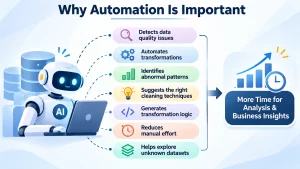
The most obvious benefit of using AI in the process of data cleansing is productivity.
Organizations usually deal with millions of records received from various sources. The manual inspection of such datasets becomes unreasonable.
AI can assist with:
- Detection of data quality problems
- Automated transformation
- Detection of abnormal patterns
- Recommending proper data cleansing techniques
- Creation of transformation logic
- Decreasing the effort
- Exploration of unknown datasets by analysts
This enables analysts to dedicate more time to analysis and interpretation of business value rather than to routine preparations.
But speed must not be an equivalent of accuracy.
The Problem with Automatically “Correct” Data
The biggest problem when using AI for data cleaning is the possibility that the data will be correct, but actually incorrect.
The system is able to find correlations and anomalies based on the available information. This means that the system will notice that two certain values look alike or one particular value stands out.
However, data in business often have some exceptions that require knowledge of the business itself.
For instance, an anomaly that appears to be an error statistically speaking might be a really important transaction made by a high-value customer.
The same concerns missing values. The replacement of all missing values with an average might be misleading because sometimes it means something different according to the business.
That is why human involvement is crucial.
AI Is Not Always Aware of Business Context
The data cleaning is not just a technical task.
It is also a business one.
The analyst should know what a certain field means, why there are missing values, which exceptions are valid, and how transformations might affect the final result.
While an AI program may detect patterns very well, it does not mean that it understands their business implications.
It is especially dangerous when working with financial, healthcare, customer, operation, or any other critical business data.
A transformation which may seem rational from the technical point of view could completely alter the meaning of the data.
The Danger of Excessive Automation
With increasingly more capable AI programs, it may become tempting to automate all steps of data preparation process.
There are several dangers here.
Firstly, an automated process could potentially make wrong assumptions, delete outliers, change values, handle missing data, or make changes which would be hard to notice by analysts.
Secondly, transparency should be considered.
When an AI program makes several automatic transformations, it is important to know such details:
- What was changed?
- Why was it changed?
- By what rules?
- On how many records?
- Can the transformation be undone?
- Was the transformation authorized?
Otherwise, it will be hard to trust the result of transformation.
The Human-in-the-Loop Approach Is Preferable
It is not necessary that the future of data cleaning is about picking one out of the two approaches – human or AI.
A better approach would be the human-in-the-loop data preparation where AI could detect the problems and suggest possible transformations and analysts would approve such transformations.
That way:
AI will contribute its speed and automation, while humans will supply it with context and judgment.
This solution will allow organizations to use AI and its capabilities without considering them perfect.
Data Validation Will Become Critical
With the rise of the amount of automated data preparation procedures, data validation will also become more relevant.
The data should be compared before and after its transformation, checking if there were any unexpected changes to its characteristics.
When doing so, the following characteristics of data should be taken into account: completeness, consistency, accuracy, uniqueness, validity, and conformity with business rules.
The history of data transformations should also be preserved for future referencing.
So, automatization will not remove data validation. It will make it more systematic.
What Does It Mean for Data Analysts?
AI-assisted data cleaning will likely transform the job of the data analyst rather than replace it.
Data analysts are going to spend less time on the repetitive transformation work and more time on:
- Assessing the recommendations offered by the AI system
- Learning about the business situation
- Verifying the quality of data
- Formulating the correct transformation rules
- Exploring anomalies
- Transparency assurance
- Interacting with business stakeholders and communicating insights
This increases the importance of critical thinking and subject matter expertise.
Knowing how to work with AI will be useful, but being able to tell when the output should not be trusted is even more important.
Understanding the practical responsibilities of data analysts is equally important. A real-world example of UPI data analysis explains how raw data is processed and converted into meaningful insights.
Should We Trust the Automated Transformations?
The answer to this question is:
We can trust them conditionally, but not blindly.
AI-assisted transformations can be highly useful in the case of repetitive, well-defined, and low-risk transformations. Still, transformations that carry some business meaning and/or impact critical decisions require proper human review.
Our goal is not to remove humans from the data cleaning process.
Our goal is to use AI in order to make the data analysts faster and better.
Conclusion
AI technology is revolutionizing how data analysts prepare data. Functions that used to take lots of time can now be performed using assistance from smart machines.
However, data that looks clean may not actually be clean data.
The issue is not only about AI doing the task of transforming the data; it is making sure that the transformations maintain the accuracy, validity, and meaning of the original data.
Data cleaning in the future will be done through collaboration between AI and humans.