

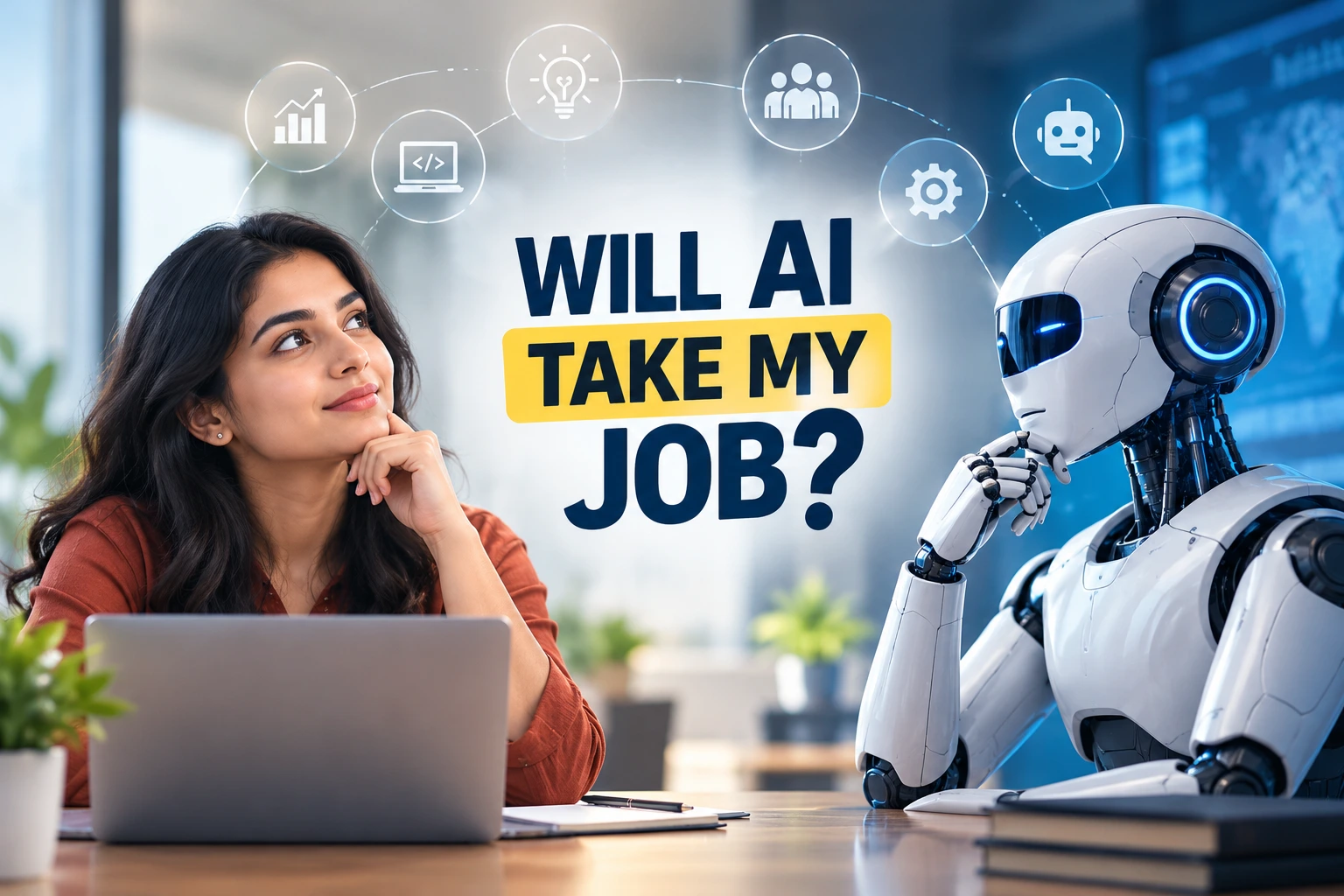
Last month, one of my students pasted a broken Django view into an AI tool. Within ten seconds, he had a corrected version with explanatory comments. He looked at me and asked, “Miss, why am I still learning all this?”
His question reflects a growing concern among students and professionals today: Will AI take my job? I did not have a clear answer at that moment. I do now. But first, I want to acknowledge that the concern behind his question is legitimate.
The concern is real
Every few months, a new AI model does something that seemed unrealistic a year earlier. It writes code, drafts emails, summarises lengthy documents, and produces designs. When a skill you spent years building is performed by a machine in seconds, discomfort is a reasonable response. This raises an important question for many professionals: Will AI take my job, or will it change the way I work?
I work as a Python trainer cum developer. Writing code is the core of my profession, and AI now writes code. So I will not claim that nothing will change. Some roles will shrink, and some tasks will disappear. Being honest about that serves people better than false comfort.
What history suggests
When spreadsheets arrived, accounting did not disappear. The hours of manual addition did. Accountants who learned the new tool became more valuable, because one person could now handle work that previously needed several.
The pattern repeats. A new technology makes routine work cheaper, and the people who adapt take on the more responsible part of the job. Those who ignore the technology fall behind. In most cases, the person who replaces you is not the tool but a colleague who uses it well.
This is what I now tell my students: AI may not take your job, but someone who uses AI effectively might.
Where AI still falls short
The code my student received ran without errors. However, it ignored a business rule that only he knew about, because he had not included it in his prompt. AI answers the question it is given. It cannot tell you which question you should have asked.
That gap is where professional value sits. Understanding what a client actually needs, spotting requirements that contradict each other, deciding what to build first and explaining a technical problem to a concerned manager are the skills organisations pay for. Typing code was never the hardest part of software development. It was simply the most visible part.
AI also makes mistakes with complete confidence. Someone has to review its output and recognise when it is wrong, and that requires a solid grasp of the fundamentals. This is why I insist that my students do not skip the basics, even though AI can produce basic code on demand. Without the foundation, you cannot verify the result.
What I am doing about it
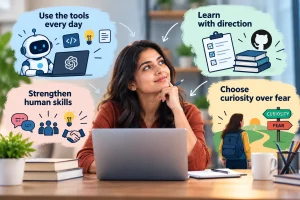
These are practices I follow myself, not just advice I give.
Use the tools every day: I use AI for debugging, for generating practice questions for my classes and for explaining the same concept in different ways. I treat it as a fast junior colleague who is usually right and occasionally wrong.
Learn with direction: Watching ten unrelated tutorials is not a strategy. Choose one area, build real projects and publish them on GitHub. A project you can explain in detail carries more weight than a certificate, and an interviewer can usually tell within minutes whether you built something yourself.
Strengthen human skills: Communication, clear thinking, patience and teamwork are the hardest abilities to automate. They are no longer supporting skills. For many roles, they are the main ones.
Choose curiosity over fear: Fear makes people hesitate, while curiosity gets them to try a new tool on a quiet weekend. Over a year, that difference compounds.
For those currently job hunting
If you are learning new skills and applying widely, it can feel as though the ground keeps shifting. It does. Still, companies continue to need people who can think, build, fix, explain, and take responsibility. When something fails in production, a person must answer for it. AI cannot take that responsibility alone.
For students and job seekers wondering, “Will AI take my job?”, the entry-level path is also changing. Interviewers are increasingly likely to ask not whether you use AI, but how you use it. Prepare to answer with a concrete example from your own work.
Back to my student
I told him, “AI gave you the answer. Now explain why it works, what could break it, and what the client will ask next.” He could not answer all three that day, which is exactly why he is still learning. By the end of the week, he could.
Nobody knows exactly how this will unfold. But I would rather understand the technology than fear it. Keep learning, keep building, and be the person in the room who can say, “This does not look right.”
That person is not easily replaced. Understanding the ethics of artificial intelligence is essential for addressing data privacy, algorithmic bias, and the responsible use of AI technologies. Explore more about privacy, bias, and responsible AI practices.