


The Future of Data Science is evolving significantly as the field has changed over the past few years. Previously, a data science project could be described in terms of gathering data, its cleaning and exploration, creating a machine learning model, and visualization. However, nowadays, there are a lot more steps involved.
Today, data scientists work with big data platforms, cloud infrastructure, machine learning models, Generative AI, LLMs, various automation tools, and AI-powered platforms for software development. As a result, all these technologies change the practice of data science in a significant way.
Nevertheless, the basics remain the same. Statistics, programming, data preparation, machine learning, and business understanding are the core elements of Data Science. Therefore, professionals just get access to more tools that make the completion of these steps easier and quicker.
The Evolving Data Science Workflow
A classical workflow of a machine learning project includes the following stages:
Data Collection
↓
Data Cleaning
↓
Exploratory Data Analysis
↓
Feature Engineering
↓
Model Development
↓
Model Evaluation
↓
Deployment
↓
Monitoring
This workflow is very common and will stay in use in the future. However, every step now has an increasing number of tools supporting it. These changes are shaping the Future of Data Science and making the workflow more efficient.
For example, there are automated solutions for data preparation, developers have additional tools to work with Python and SQL codes, and the model deployment is constantly checked and adjusted by monitoring systems.
In other words, Data Science is not limited anymore to creating a model. It also includes gathering, preparing, deploying, monitoring, and maintenance of the data.
Data Engineering and Data Science
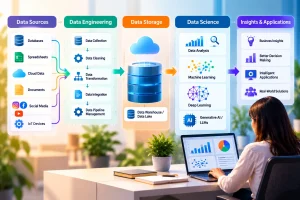
The accuracy of predictions depends on the data used to train a machine learning model. Therefore, data engineering plays an essential role in the Data Science ecosystem.
When working with various information sources, data scientists deal with data provided by databases, APIs, cloud storage, applications, spreadsheets, and other sources. However, integrating such sources becomes a complex task for large and often updated datasets.
In addition, the technologies used for implementing pipelines include Python, SQL, Apache Spark, Apache Kafka, Airflow, and cloud data warehouses.
Usually, a pipeline includes components such as:
Data Sources
↓
Data Ingestion
↓
Data Cleaning & Transformation
↓
Data Warehouse / Data Lake
↓
Analysis & Machine Learning
↓
Dashboard / Application
Understanding how data flows through this pipeline will allow data scientists to collaborate with data engineers and build feasible solutions.
Data Preparation
Preparation of data is probably not the most exciting part of Data Science, but it is one of the most critical ones.
In the real world, the datasets are not always in perfect shape and require cleaning. Such problems may include missing values, duplicate records, wrong data types, different formatting, and peculiar records.
The most common data pre-processing operations are:
- Dealing with missing values
- Deleting duplicates
- Data type conversion
- Finding outliers
- Categorical variable encoding
- Numerical feature scaling
- Creating new variables
Various tools can automate the process partially nowadays, but an analyst or a data scientist still needs to know the details of the data to know how it should be transformed.
Replacing each missing value with zero will make the dataset ready to work but will change its meaning completely.
Feature Engineering
Feature engineering is a process of creation of variables out of the existing data.
Assume we have a sales dataset consisting of columns such as:
- Transaction Date
- Customer ID
- Product Price
- Quantity
The data scientist will be able to create some extra features like:
- Total Amount
- Purchase Month
- Day of Week
- Customer Purchase Frequency
- Average Order Value
It will give some additional data to the machine learning algorithms.
However, there are tools that allow generating feature candidates, but to choose relevant features, you need to understand the business problem and the dataset itself.
Therefore, this area of the work remains one of those that cannot be fully automated with machine learning and still requires human reasoning.
Machine Learning in Data Science
Machine Learning is a crucial aspect of Data Science which allows systems to learn patterns from data collected before and use the patterns for making decisions without coding each decision separately.
In general, the process of working with Machine Learning usually includes steps such as preparing a dataset, selecting important features, splitting the data into train and test datasets, choosing the right algorithm, training the model, and evaluating its efficiency. As a result, Machine Learning will continue to play an important role in the Future of Data Science, particularly as AI-powered technologies become more widely used.
Machine learning methods can usually be separated into several groups:
- Supervised Learning – The model is trained on labelled data. It is widely used for tasks such as predicting housing prices, identifying fraudulent operations and customer classification.
- Unsupervised Learning– The system processes unlabelled data and looks for some patterns or groups in the data. Clustering and dimensionality reduction are typical examples of unsupervised learning.
- Reinforcement Learning– The system receives some feedback on its behaviour and adjusts itself based on the feedback. This approach is most widely used in fields such as robotics, recommendation systems and gaming systems.
Popular Machine Learning Algorithms
- Linear regression
- Logistic regression
- Decision tree
- Random forest
- Support vector machine
- K-nearest neighbours
- K-means clustering
- Gradient boosting
Python libraries such as Scikit-learn include a lot of implementations of machine learning algorithms and can be effectively used for experiments and model development.
Additionally, another aspect of machine learning process is the evaluation of model. Evaluation criteria depends on the problem. The regression model can be evaluated using MAE, MSE and R² criteria, while classification model can be evaluated using metrics such as accuracy, precision, recall, F1-score and ROC-AUC.
However, machine learning model can also be affected by some issues like overfitting and underfitting. Overfitting happens when the model learns the training set too well and cannot work properly with new data. On the other hand, underfitting happens when the model is too simple to catch important patterns in the dataset.
Thus, Machine Learning still remains one of the key elements of Data Science. Knowledge about machine learning algorithms, evaluation methods, data preprocessing and model flaws is the basis for more advanced topics such as Deep Learning and Generative AI. Therefore, these developments will continue to contribute to the Future of Data Science.
Deep Learning in Data Science
Deep Learning is a special field of machine learning which implies the use of multilayered neural networks to learn complicated patterns from a big amount of data. In contrast to most machine learning algorithms, deep learning models do not rely on feature selection and can learn features automatically from raw data.
Moreover, deep learning finds its application in the analysis of high-dimensional and unstructured data like images, audio, video, and text. For example, applications of deep learning include image classification, speech recognition, natural language processing, recommendation systems, and computer vision.
Furthermore, the key component of deep learning is the neural network. In the typical architecture, there is an input layer, one or several hidden layers, and an output layer. During the training process, the model compares predictions with the actual outcomes and minimizes error by optimizing using, for example, gradient descent.
Some popular neural network architectures are:
- Convolutional Neural Networks (CNNs) for images and computer vision
- Recurrent Neural Networks (RNNs) for time series and sequential data
- Long Short-Term Memory (LSTM) networks for long term dependencies in sequential data
- Transformers for languages, texts, and other sequence data
There are many frameworks like TensorFlow and PyTorch that are used to build, train and evaluate deep learning models.
Deep learning can give great results but is associated with certain challenges. For example, deep learning requires lots of data, big computational resources, long training time, and much attention to proper tuning of the model.
Generative AI in Data Science
Generative AI has added a new layer to working with data and code.
The Data Scientist can employ AI-based tools to aid with tasks like:
- Code generation for Python scripts
- SQL generation
- Code explanation
- Visualization generation
- Documentation preparation
- ML techniques suggestion
- Summary generation
For instance, instead of wasting a few minutes on finding out the syntax for a certain Pandas operation, one can formulate the requirements and get a possible implementation.
Nevertheless, the generated code cannot be blindly trusted and blindly copied and used in the project because it may be wrong or does not meet the project requirements.
It is more important to understand the code than generate it.
AI-Assisted Development
Programming is an important part of Data Science, especially when working with Python, SQL, machine learning, and data pipelines.
Moreover, AI-assisted development tools like GitHub Copilot can accelerate this process by providing code suggestions while the developer works on it.
For instance, the data scientist writes a comment explaining the task and gets possible implementations.
GitHub Copilot can suggest implementations of:
- Pandas and NumPy operations
- SQL queries
- Scripts for data cleaning
- Matplotlib and Plotly visualizations
- Scikit-learn workflow
- Functions and reusable code
- Documentation and comments
- Test cases
What is important, it does not just generate all the code for the developer. What is even more important is that the tool eliminates the need for repetitive coding and helps experts to implement their ideas faster.
The Data Scientist has to understand the logic, test the output and check whether the implementation is correct for the problem.
Large Language Models in Data Science
Another application of large language models is in data science.
The tool can help users work with information using natural language instead of programming or other interfaces.
For example, an analyst can ask for the performance summary or SQL script to fetch a specific information.
Large Language Models can help with:
- Code generation
- SQL assistance
- Documentation preparation
- Information summaries
- Technical explanations
- Report preparation
At the same time, Large Language Models can provide incorrect information. Thus, validation is extremely important for any technical or business-critical applications.
Retrieval-Augmented Generation (RAG)

Retrieval-Augmented Generation, or RAG, is another important invention associated with Data Science and LLM application.
A typical RAG system fetches information from some external source and generates a response.
The above process could be described as follows:
User Question
↓
Search / Retrieval
↓
Relevant Information
↓
Language Model
↓
Generated Response
For instance, a company may create a system that will search its internal documentation to answer questions raised by employees.
However, the performance of such a system would depend on certain technical factors like data quality, document processing, chunking, embeddings, retrieval, and evaluation.
Therefore, there are opportunities for data scientists to collaborate not only with machine learning models but also with search systems and language models.
AI Agents in Data Science
Another direction is related to the use of AI agents. Unlike a single instruction, the agent performs a series of operations to reach a particular goal.
For instance, an analytics agent can:
- Retrieve a dataset
- Analyse its structure
- Find data quality problems
- Create pre-processing code
- Perform exploratory data analysis
- Create visualizations
- Find peculiarities
- Summarize information
Such a workflow can minimize the amount of routine operations in an analytics project.
Of course, there should be a control mechanism. Data scientists need to verify the results and prevent the automation from introducing mistakes to the analytics process.
MLOps and Production Machine Learning
Creating a machine learning model in a Jupyter Notebook is just one step in a real-world project. Once deployed, it should be maintained. MLOps combines software engineering and machine learning practices for this purpose.
The key aspects are:
- Model versioning
- Data versioning
- Automated testing
- Model deployment
- Performance monitoring
- Data drift detection
- Model retraining
For instance, a customer churn model can function well after it was deployed. The behavior of customers may change, resulting in low-quality predictions of the model.
Monitoring systems would be able to detect these changes and suggest when the model should be updated or retrained.
Real-time Data and Machine Learning
There are many applications which cannot wait for the processing of data at the end of a day or a week.
For instance, in banking, a transaction should be analyzed in real-time mode. It means that the processing should happen in seconds.
The same applies to such cases as:
- Fraud detection
- Cybersecurity
- Recommendation systems
- Predictive maintenance
- Logistics
- Financial monitoring
Technologies like Apache Kafka and Apache Spark can be used for building such systems.
In other words, this is another field of intersection of Data Science and data engineering/development, contributing to the Future of Data Science.
Responsible Data Science
With growing complexity of data science infrastructure, responsible data usage becomes critical.
Main aspects include:
Data Privacy
Confidential data has to be stored and used in a secure manner.
Bias
Machine learning models learn unintended patterns from biased data sets.
Explainability
In some cases, businesses have to know the grounds for particular model decisions.
Security
Data flows, models, APIs, and applications need proper protection.
Human Supervision
Key decisions cannot be passed to algorithms automatically without a proper evaluation.
Thus, good Data Science is not only about high-quality model performance. Reliability, ethicality, privacy, and proper usage are also crucial.
Skills Data Scientists Need Today

The scope of data scientists’ responsibilities is increasing. Machine learning is still an important skill, but it is not sufficient anymore.
Key technical skills include:
- Python
- SQL
- Statistics
- Machine Learning
- Deep Learning
- Pandas
- NumPy
- Data Visualization
- Git & GitHub
- Cloud computing
- MLOps
- Generative AI
- Large Language Models
- RAG
- AI agents
Together with technical knowledge, communication and business understanding are invaluable. These skills are becoming increasingly important for professionals preparing for the Future of Data Science.
A data scientist may create a great model but cannot deliver its results to the business team due to a lack of understanding of the problem. In this case, the created solution will never be used to generate any value.
Changing Role of Data Scientists
Automation has brought a number of changes into the sphere of data scientists’ activities, with one of the most significant being the reduction of repetitive technical work.
For example, basic coding, creating common visualizations, generating documentation and conducting routine analysis can be done with the help of software now.
However, it doesn’t mean that the role of a data scientist becomes irrelevant because of that.
On the contrary, it means that data scientists can invest their efforts into something else.
Data scientists can now devote their time to:
- Understand business needs
- Select appropriate analytical techniques
- Design experiments
- Evaluate the reliability of models
- Interpret results
- Conduct effective communication
- Solve problems
As the roles and responsibilities in Data Science continue to evolve, understanding the differences between data analysts and data scientists can help aspiring professionals choose the right career path.
Future Developments in Data Science
In the years to come, the practice of Data Science is likely to move towards the integration of classical statistics approaches with machine learning, data engineering, software development, and artificial intelligence technologies.
Moreover, the future of Data Science will probably see the increased usage of such technologies as automated data preparation, generative AI, AI-assisted development, AI agents, real-time analytics, MLOps, cloud-based machine learning, and responsible AI.
However, all these advancements are not making the fundamentals of Data Science outdated.
Therefore, the basics of statistics, programming skills, the ability to ensure data quality, critical thinking and domain knowledge will always be the key aspects of successful analytical activity. In addition, data scientists will increasingly need to work with advanced tools while maintaining a strong understanding of the underlying analytical processes. At the same time, these professionals will need to evaluate data quality, model results, and AI-generated outputs carefully. Ultimately, combining technical skills with critical thinking and domain knowledge will remain important as Data Science continues to evolve.
Conclusion
Data Science is changing, but the essence of the profession remains unchanged – the utilization of the data for solving problems.
Moreover, technologies make many processes in the Data Science workflow much quicker and simpler – from coding, data preparation to model development and post-deployment monitoring. Technologies such as GitHub Copilot, Generative AI, RAG systems, and AI agents become part of the modern workflow.
However, the data science specialists are unlikely to become those who possess all the new tools. The valuable data professional is the one who has the solid knowledge of the fundamentals, knows how and when to use specific technologies, and can combine technical skills with critical thinking and business knowledge.
Thus, the future of Data Science is not about humans or technology only.