

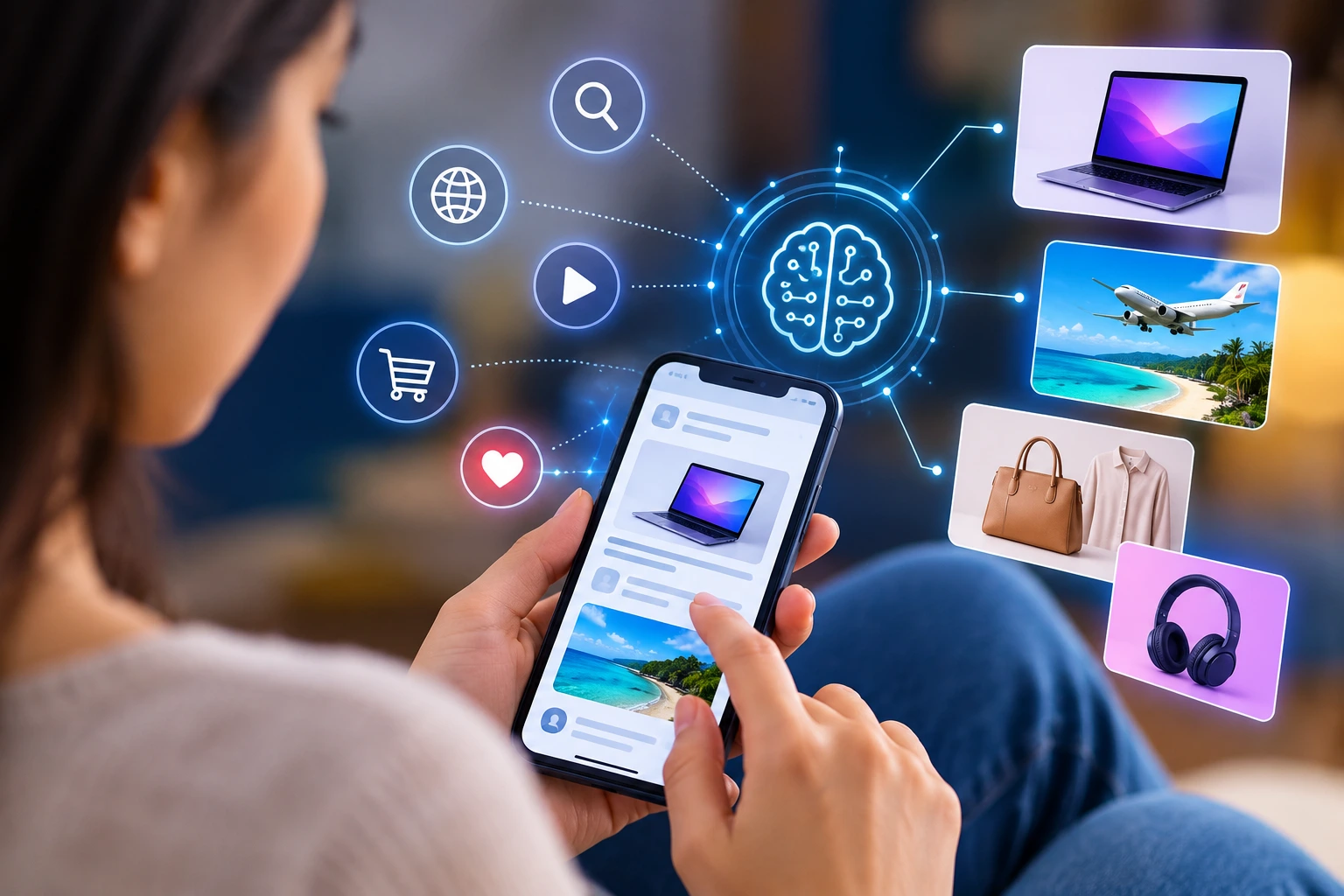
How phones predict your interests is an interesting example of how Data Science, Artificial Intelligence (AI), and Machine Learning (ML) work together. Have you ever talked about purchasing a new phone and then started receiving smartphone ads? Or searched for travel information and noticed related videos, recommendations, and flight prices?
Sometimes, it seems that your phone can read your mind. However, these experiences are often explained by how AI-powered recommendation systems analyze your digital footprint and predict what you might be interested in.
Digital Footprints Tell About Your Actions
Each time when you use your phone you leave digital footprints. It means that you search for something, watch videos, like posts, browse websites, compare products, listen to songs, or read a lot of certain kinds of information.
Separately each action may not look like anything important. But in combination they may show certain patterns.
Imagine that you search for the phrase “best laptop for programming,” watch some laptop reviews and visit some shopping websites. A recommender system will find patterns and predict that you are looking for a laptop.
Making Predictions with Machine Learning
The general scheme could be described as:
User Action → Data → Patterns Discovery → Machine Learning → Prediction → Recommendations
Machine Learning algorithms are built in such a way that they detect patterns and relationships from vast amounts of data. Your actions in relation to the content can be used as signals to determine which other types of content or products you might be interested in.
For instance, if you watch a lot of videos on Python and Machine Learning, a recommendation system will assume that you would also like Data Science, Deep Learning, or Artificial Intelligence content.
That’s one of the reasons why you and your friend may see entirely different content on the same platform.
Recommendation Systems: A Plentiful Application of Data Science
Recommendation systems are perhaps the most obvious application of Data Science.
Streaming services recommend movies and TV shows. Music apps recommend songs and playlists. E-commerce websites recommend products. Social media sites recommend posts and videos.
Why?
“What will the user find interesting?”
The algorithm takes into account previous actions and predicts the relevance of various possibilities.
Are You Really Being Listened To By Your Phone?
This is when controversy begins.
When you speak of something and then see an advertisement of what you were discussing, it’s understandable that you think that your phone was listening. But the appearance of the advertisement doesn’t mean your phone recorded your conversation secretly.
There can be lots of other reasons. You could previously searched this topic, interacted with this information, visited websites connected with it or noticed the ad just because you thought of this issue.
Current recommendation systems can predict really amazing stuff without even hearing what you say.
The Issue of Privacy

This technology is good, but still, it poses some issues concerning privacy.
The more data your system has, the more accurately the recommendations would be made. So, the users need to monitor the permissions that they give to apps and their privacy settings.
The main objective is not only to make intelligent AI, but also responsible one.
AI is transforming not only our personal digital experiences but also the modern workplace. From personalized recommendations to AI-powered workplace tools, intelligent systems use data to improve efficiency and decision-making. Learn more about the “Impact of AI on the Workplace” and how artificial intelligence is changing the way people work.
Concluding Remarks
Your phone is likely not mind-reading. Instead, how phones predict your interests depends on analyzing the digital footprints you leave behind.
Every click, search, view, like, and interaction provides valuable information. Data Science helps analyze this data, Machine Learning discovers patterns, and Artificial Intelligence uses these patterns to predict your interests and personalize recommendations.
Therefore, when your phone somehow “knows” what you have been thinking about, remember this: it may not know your thoughts, but it can use your digital activities to predict what you might do next.