
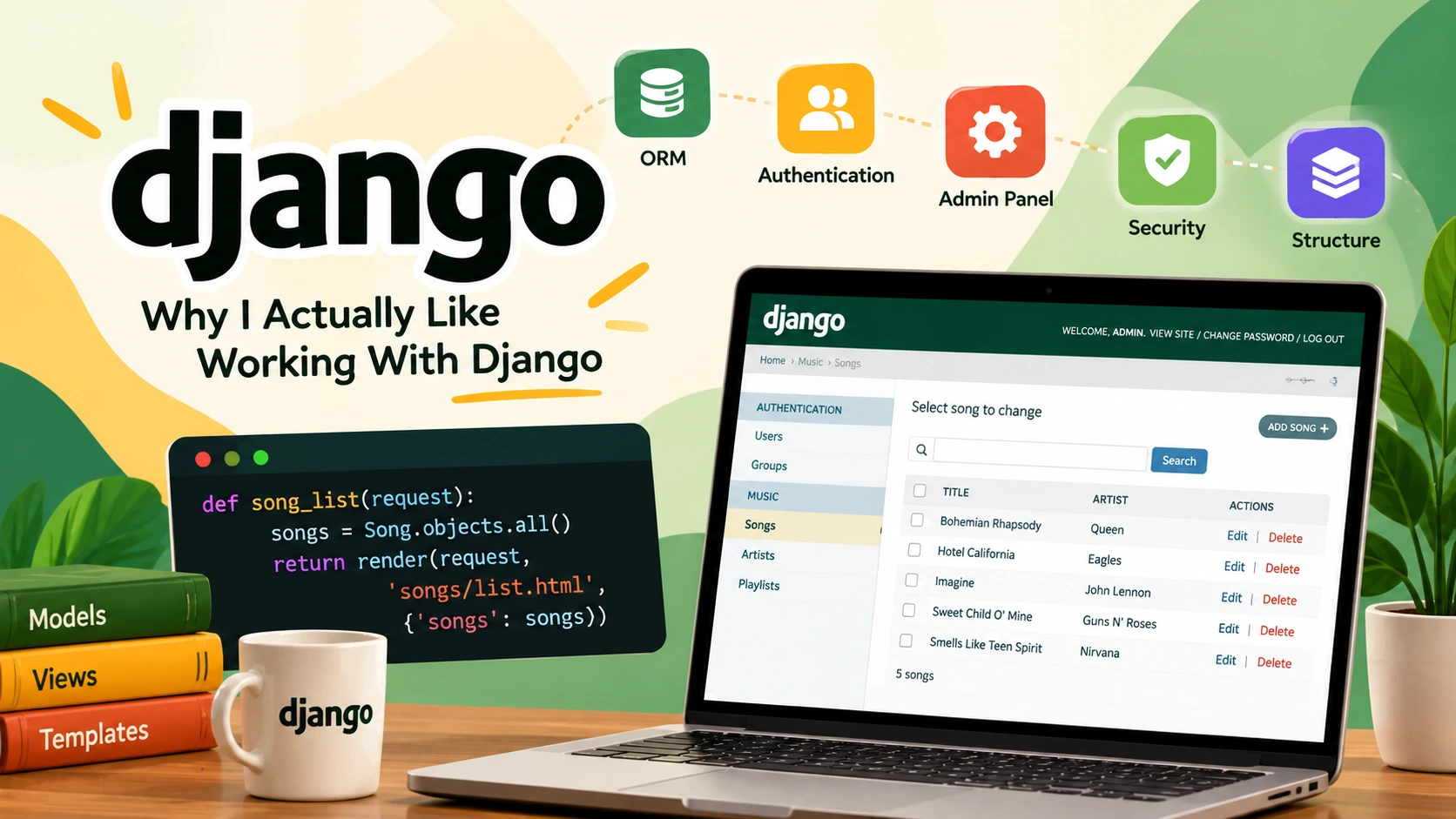
I still remember the first time I worked with the Django framework, registered a model in its admin panel, and got a full working interface — search bar, filters, edit forms, all of it — without writing a single line of HTML. I sat there for a second just refreshing the page like it was a magic trick. It kind of is.
If you're on the fence about learning Django Framework, or you've heard the name thrown around and wondered what the fuss is about, here's my honest take on why it's stuck with me.
It Doesn't Make You Reinvent the Wheel
A lot of frameworks hand you a router and say "good luck." Django isn't like that. Out of the box, you get a database layer (the ORM), user login and permissions, form handling, an admin dashboard, and a templating system for your HTML — all built to work together instead of feeling bolted on.
That matters more than it sounds like it should. When you're building something on your own — a side project, a client app, whatever — the last thing you want is to spend your first week just wiring libraries together before you've written a single feature. With Django, you're writing actual app logic almost immediately.
The Structure Actually Makes Sense
Django organizes things into models, views, and templates. Once it clicks, it really clicks:
– The model is just your data — what a "Song" or "Playlist" looks like.
– The view is the logic — what should happen when someone visits a page.
– The template is what they actually see.
Here's roughly what that looks like for something simple, like showing a list of songs:
python
def song_list(request):
songs = Song.objects.all()
return render(request, 'songs/list.html', )
That's it. No boilerplate, no ceremony. You fetch the data, hand it to a template, done.
The Admin Panel Still Feels Like Cheating
Honestly, this is the feature that sold me. You write a model:
python
class Song(models.Model):
title = models.CharField(max_length=200)
artist = models.ForeignKey(Artist, on_delete=models.CASCADE)
Register it:
admin.site.register(Song)
And suddenly you have a real back-office tool. Add songs, edit them, delete them, search through them — all without touching HTML or CSS. If you've ever built an internal tool from scratch by hand, you know how much time this saves. It's the kind of thing that makes solo developers feel like they have a whole back-end team.
Security
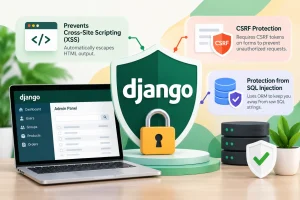
Security is one of those things that's easy to ignore until it isn't. Django quietly handles a lot of it for you — it escapes your HTML automatically so you don't accidentally open the door to cross-site scripting, it requires CSRF tokens on forms, and the ORM keeps you away from raw SQL strings, which is where SQL injection bugs usually creep in.
None of this makes your app invincible. But it means the "default" way of doing things in Django is usually also the safe way, which takes a lot of pressure off when you're moving fast.
Apps Keep Big Projects From Turning Into Spaghetti
Django encourages you to split your project into smaller "apps" — one for songs, one for playlists, one for user accounts, whatever makes sense. Each one is self-contained, with its own models and views, but they all plug into the same project.
This sounds like a small thing until your project actually grows. Six months in, being able to open the `playlists` app and know exactly where everything lives — without wading through an unrelated `accounts` folder — is genuinely nice.
When the Django Framework Isn't the Right Tool
I don't think Django is the answer to everything. If you just need a small, fast API with no admin panel and no traditional database, something lighter like Flask or FastAPI might get you there with less overhead. Django's strength is in full applications — the ones with users, data, an admin side, and real structure to maintain over time.
Wrapping Up
I keep coming back to Django because it gets out of my way. It's opinionated in the right places, flexible where it needs to be, and it lets me spend my time building the actual thing I care about instead of duct-taping infrastructure together. If you're building something with any real data behind it — even something like a personal music player project — there's a good chance Django will feel less like a framework you're fighting and more like one that's just quietly on your side. If you're new to Django and want to understand what to learn next, check out our Django Developer Roadmap: Learn Django Step by Step for a structured guide from the basics to advanced concepts.