

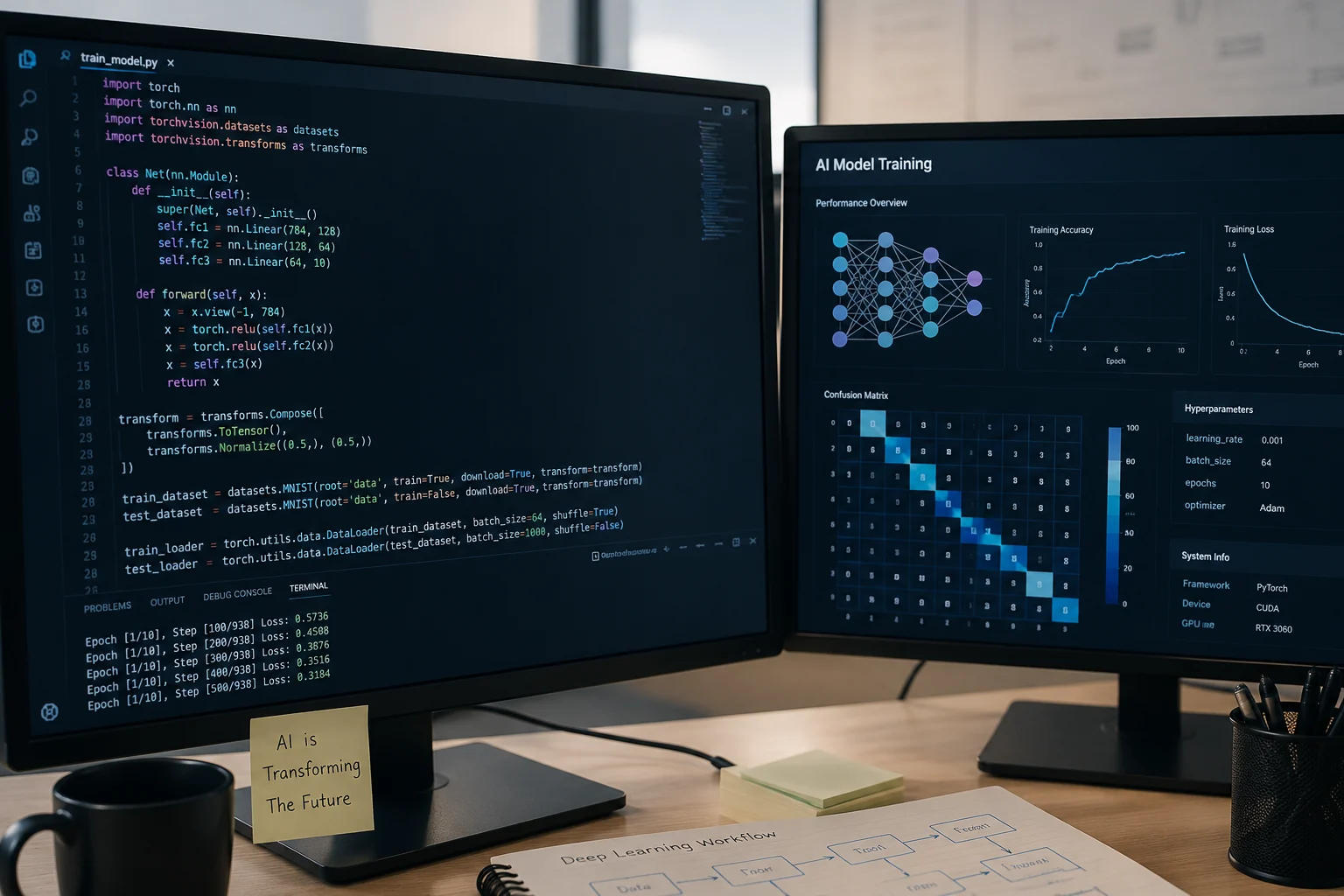

Artificial Intelligence is no longer something of the distant future. It has been integrated into our daily activities, whether it be through recommendations, chatbots, or fraud protection. The programming language behind some of the latest advancements in the AI world. That is Python, which has emerged as the preferred choice for building AI solutions.
The popularity of Python has been increasing over time. This is evident from current trends within the field. Python leads the TIOBE index by the largest margin in its 23 years of existence and recently overtook JavaScript on GitHub. AI-related job advertisements requiring knowledge of Python saw an increase of over 500%.
Why Python Is Best for AI
Thanks to Python’s easy-to-understand syntax, beginners can start coding in days. In the case of professionals, creating advanced systems does not require struggling with the programming language. Libraries take care of everything from working with datasets via NumPy and Pandas. Machine learning models using Scikit-learn, deep learning with TensorFlow and PyTorch, and computer vision via OpenCV.
Furthermore, Python is one of the languages with the biggest communities of developers across the world. Their resources and open source projects facilitate learning more than almost any other programming language. Python is irreplaceable outside AI in web, automation, cybersecurity, and cloud development.
Generative AI Revolution
Until a few years back, the term “AI” essentially referred to predictive models. In recent times, however, Generative AI and LLMs have come to the forefront, and the likes of ChatGPT, Claude, and Gemini have made it possible to create content via AI that is capable of reasoning and thinking by itself, while all of this is enabled by Python.
This revolution has introduced new tools to the regular toolkit of developers, including Hugging Face for pre-trained models and datasets, LangChain for creating agents via AI, and the API offerings of prominent AI firms (including OpenAI, Anthropic, and Google) that enable integration of language models in applications.
Why Does it Matter?
Companies are now integrating AI at an unprecedented pace as they automate processes, analyse data, and provide personalized experiences. The number of AI-related developer jobs increased from 2% to 10% between 2022 and 2024, and 44% of firms offered wage increases for AI expertise in 2025.
AI is not replacing programmers but upgrading them. Developers who know Python and AI create intelligent applications, not manage legacy systems.
Practical Application
Applications of Python and AI can be found in different industries. Industries like: healthcare (analysis of images, prediction of diseases), banking (fraud detection and analysis), education (tailored training), e-commerce (personalised recommendations, forecasts), and cybersecurity (detection and analysis of threats).
Skills to Acquire
Programming basics and OOP in Python, data analysis, basic statistics, Machine Learning, Generative AI, prompt engineering, artificial intelligence tools and APIs, web frameworks such as Django and Flask, Git/GitHub, REST API, and cloud-based API deployment. Real projects will always be the best way to convert knowledge into practical skills.
Job Positions
The demand has created many positions, including AI engineer, ML engineer, data scientist, Python developer, and NLP engineer. The pay is proof of the
Since an entry-level Python developer earns approximately $91,000, a mid-level developer $125,000, a senior developer more than $172,000, while an AI freelancer makes $120-$250 per hour.
Employers today place greater emphasis on judgment rather than mere syntax, as one needs to know how to create reliable programs. AI can help develop code, but making the right engineering choices isn’t easy.
Getting Started
Begin with Python basics and small projects, followed by data analysis and ML, before moving to AI tools and APIs. Learning Django or Flask will allow you to develop and deploy applications. Along the way, develop a portfolio; after all, practical experience counts more than certificates.
Conclusion
Python and AI technologies are set to define the next ten years of technology thanks to high demand and increasing wages. Simplicity, rich libraries, and a crucial role in the recent generative AI breakthroughs make Python an obvious choice for entering this exciting world.