

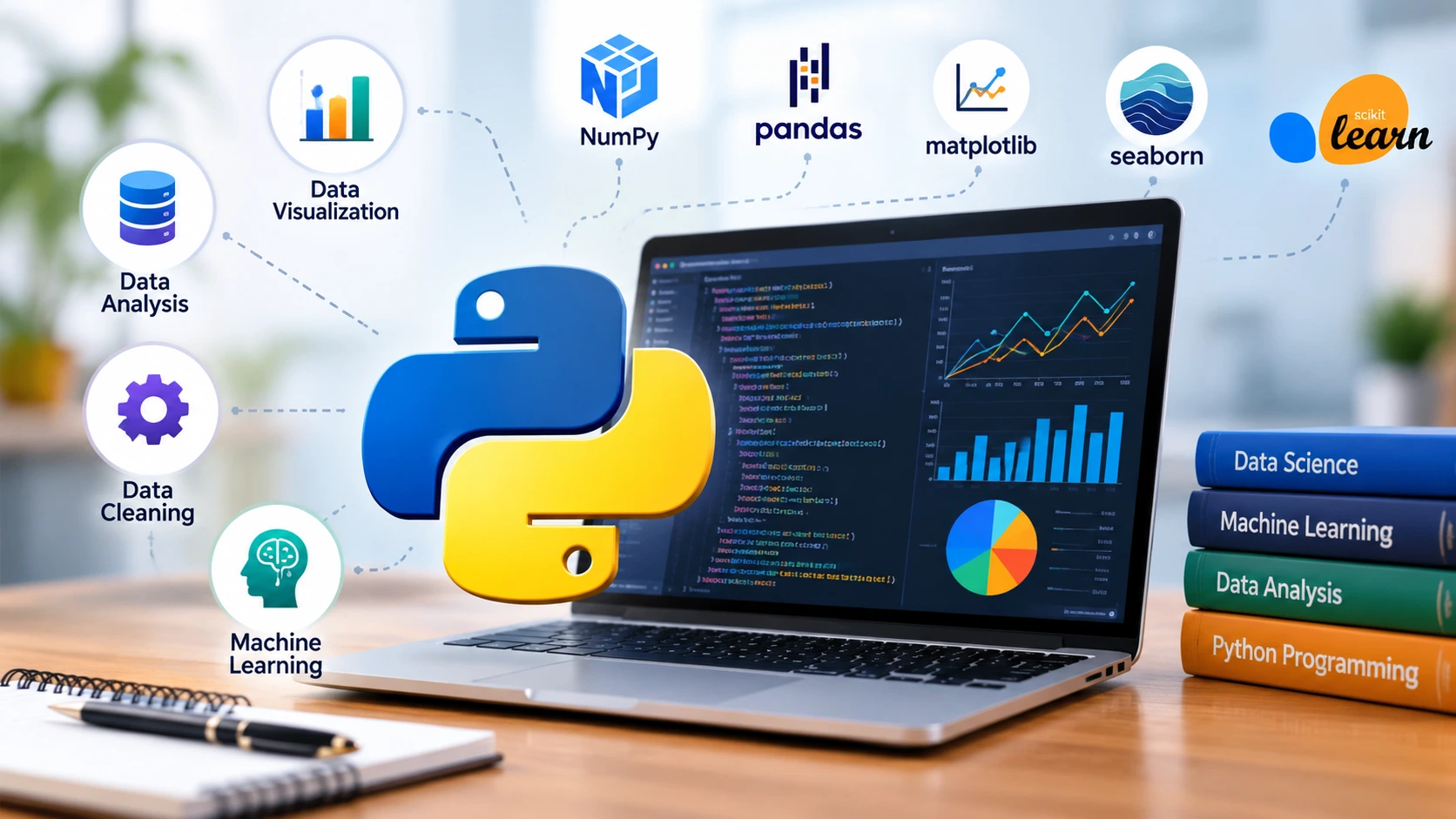
In today’s digital world, people generate massive amounts of data through websites, mobile applications, business transactions, and social media platforms. Companies analyze this data to identify patterns, solve problems, and make informed decisions. Python for Data Science plays an important role by helping professionals collect, process, analyze, and visualize data efficiently. Among the many programming languages available today, Python stands out for its simple syntax, powerful libraries, and wide range of applications in data analysis, machine learning, and artificial intelligence.
What is Python?
Python is an easy-to-use, readable programming language with simple syntax. Programmers are able to code in lesser number of lines of code as compared to many other programming languages.
Python is used in web development, automation, Artificial Intelligence, Machine Learning and Data Science.
For example, Python can be used to calculate the average marks of students, determine the highest mark or analyze sales data of a company.
Why Python is important in Data Science?
1. Easy to Learn and Use
Python has simple and readable syntax making it perfect for the beginners. This helps the data scientist to concentrate more on data analysis rather than wasting time coding.
Example:
marks = [75, 80, 90, 65, 85]
average = sum(marks)/len(marks)
print(“Average marks:”, average)
This is the code that calculates average marks of five students.
2. Useful Libraries
There are lots of useful libraries in Python that make data analysis and computations simple.
NumPy – does numerical computations and manipulations with arrays.
Pandas – manages and analyzes data in tables.
Matplotlib – makes various graphs.
Seaborn – makes statistical graphs.
Scikit-learn – used for machine learning purposes.
With these libraries, it is much easier and quicker to work.
3. Data Cleaning and Management
Any real data may include errors, duplicates, and missing values. Therefore, before analyzing it, the data has to be cleaned and managed.
The Pandas library in Python is very helpful in these situations. It allows one to find missing values, delete duplicates, rename columns and manage datasets.
4. Data Visualization
Data visualization enables people to comprehend information through graphs, charts, and plots.
Libraries like Matplotlib and Seaborn in Python can generate graphs, plots, histograms, and other visual representations.
For instance, an organization can use graphs to get an understanding of changes in sales over a period of time.
5. Machine Learning and Artificial Intelligence
The programming language is commonly used to build machine learning models and artificial intelligence.
Libraries like Scikit-learn, TensorFlow, and PyTorch enable programmers to create systems that classify, analyze, predict, and perform other functions.
For instance, machine learning models can make predictions on future sales using past sales figures. Python is widely used in AI and machine learning to analyze data and predict outcomes, similar to how AI uses personal information to understand user behavior and predict interests, as explained in Why Is It Seemingly Possible for Your Phone to Read Your Mind?
6. Works With Diverse Data Formats
Python enables people to work with Excel, CSV, database, web, and API data.
7. Large User Base
The Python community consists of developers, researchers, and students who provide many tutorials and documentation pages on the web.
This makes learning the language, solving programming issues, and learning new techniques easier.
Practical Uses of Python in Data Science

Healthcare
Python is useful in analyzing medical datasets and understanding the patterns of diseases, among other medical research activities.
Business and Marketing
Companies can utilize Python in understanding consumer behavior, performance of marketing efforts, segmentation of consumers, and forecasting of demand.
Banking
Financial organizations can use Python in analyzing transactions and detecting anomalies and risks.
Education
Educational institutions can analyze attendance of students, examination results, and trends in enrollment for improvement in their services.
E-commerce
Online shopping sites can analyze purchases and create recommendations using Python.
Challenges Associated with Using Python
While there are a number of benefits associated with Python, some of its drawbacks include:
– It may not always be faster than compiled languages when it comes to certain computational activities.
– Big datasets will require large amounts of RAM.
– Novices will take time to get acquainted with the language and its data analysis packages.
– Choice of methodology and interpretation of results will continue to demand analytical expertise.
However, Python continues to be an excellent tool for various Data Science projects despite these challenges.
Future of Python in Data Science
Python is likely to remain relevant in Data Science due to its rich libraries and application in Machine Learning and Artificial Intelligence.
As more companies rely on data for decision making, knowledge of Python can help professionals handle datasets and come up with data analysis solutions and predictions.
Combined with statistics, SQL, visualization techniques and machine learning skills, Python programming can help professionals become experts in Data Science.
Conclusion
Python is relevant in Data Science due to its user-friendliness, flexibility and libraries. It enables data scientists to work with data, carry out calculations, visualize data, and create machine learning models.