

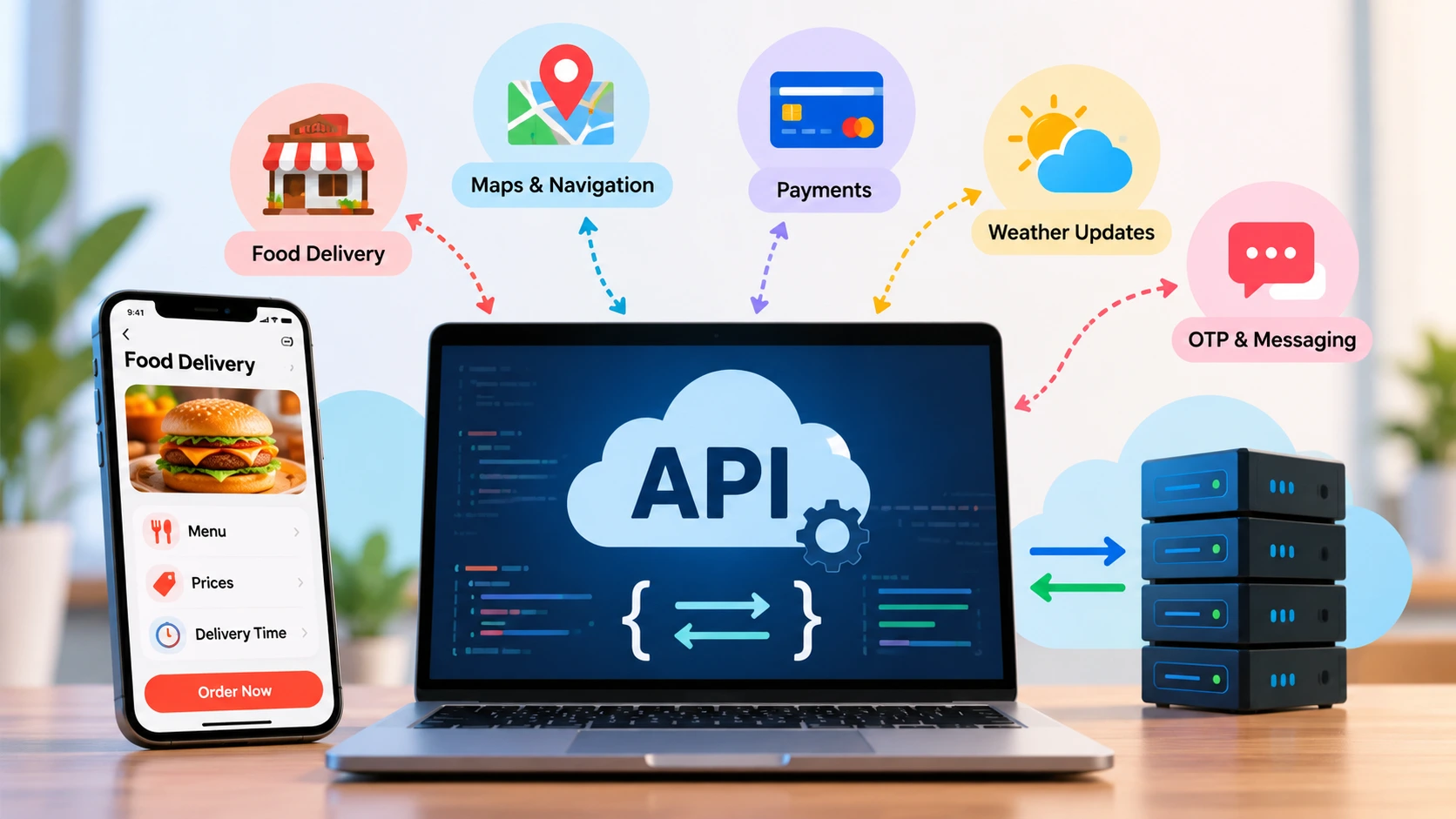
Ever ordered food through an app and wondered how your phone “talks” to a restaurant’s kitchen? You didn’t call them or walk in to ask what’s available. Yet, within seconds, the menu, prices, and delivery time just… appear. Feels like magic, right? It’s not magic. It’s an API quietly doing its job behind the scenes.
What Is an API and How Does It Work?
Let’s be honest, the term “API” — Application Programming Interface — sounds intimidating the first time you hear it. But strip away the jargon, and it’s one of the simplest ideas in tech. Think about a restaurant for a second. You don’t walk into the kitchen and instruct the chef yourself. You tell the waiter what you want, the waiter passes it to the kitchen, and eventually your food arrives at the table. You never see the chaos happening in the kitchen, and honestly, you don’t need to.
That’s exactly what an API does. It’s the waiter standing between two pieces of software. One system says, “I need today’s weather for Kochi,” and the API carries that request to the weather service, waits for the answer, and brings it back neatly packaged. Your app never needs to understand how the weather service stores its data internally — it just needs to know how to ask, and how to listen.
So here’s the simplest way to remember it: an API is a set of rules that lets two different software systems have a conversation, without either one needing to know how the other works on the inside.
Real-Life Examples and Benefits of APIs
Now, why should you actually care about this? Because APIs are everywhere, running quietly under almost everything you do online. For example, logging into a website using your Google account? API. For example, watching a live map update while your cab approaches? API.
Even your fitness band syncing steps to your phone overnight uses an API, working while you sleep. Once you start noticing them, you can’t stop seeing them.
Moreover, for businesses and developers, this is a massive deal. Nobody wants to build a payment system from scratch when there are trusted, battle-tested APIs already doing that job securely. For instance, need to send OTP messages? There’s an API. Need to verify an address or convert currencies? An API exists for that too. As a result, instead of reinventing the wheel every single time, developers plug into these ready-made services and spend their energy on what actually makes their product special.
But how does this work behind the scenes? Most modern APIs follow a style called REST, and honestly, it’s not as scary as it sounds. The API exposes certain “doors” you can knock on, called endpoints, and each door understands a specific kind of request. To fetch information, use a GET request. Meanwhile, to submit something new, such as creating an account, use a POST request. Updating your profile picture? PUT or PATCH. Deleting an old post? DELETE. Meanwhile, data usually travels as JSON — a neat, readable format that both humans and machines can make sense of without a headache.
However, here’s something people often get wrong: they assume APIs are only for giant tech companies with huge engineering teams. Not true at all. In fact, even a small local business website uses APIs constantly, whether it’s for accepting card payments, sending confirmation emails, or embedding a live chat box in the corner of the screen. Similarly, even absolute beginners learning to code often start their journey by playing with free public APIs — pulling random jokes, cat facts, or live cricket scores into a simple project just for fun.
That’s where the real benefit becomes clear. Once you understand how to send a request and read the response that comes back, you unlock an entire universe of ready-built functionality. For those interested in building APIs, learning Django is a great next step. Explore Creating Feature-rich APIs in Django for Beginners to learn how APIs can be developed using the Django framework. Instead of building everything from zero, you start connecting powerful pieces together like puzzle blocks, and suddenly what felt impossible becomes an afternoon project.
So, the next time your phone shows you live traffic, processes a payment in two seconds, or logs you in without asking for a new password, take a second to appreciate the quiet messenger working behind it. No spotlight, no credit, just a reliable API doing exactly what it was built to do — carrying requests and responses back and forth, so software systems can cooperate without ever needing to fully understand each other.
Ultimately, once this clicks, you’ll never look at an app the same way again. You’ll start seeing APIs everywhere — because, honestly, they really are everywhere.