

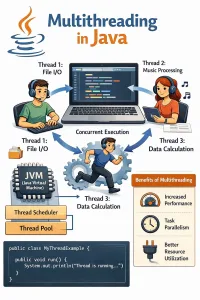

Multithreading in Java: Basics You Should Know in today's fast-paced development environment, the process of building applications increasingly demands rapid, responsive, and efficient software. To meet these requirements, gaining a clear understanding of Multithreading in Java: Basics You Should Know, including Java threading fundamentals and core concurrency concepts, is essential, as one of the most effective approaches in Java programming is the use of multithreading. By leveraging Java multithreading concepts, concurrent execution, and parallel processing, multiple tasks or operations can be executed at the same time, thereby improving overall performance and application responsiveness.
In this post, we will gradually explore Multithreading in Java: covering Java thread basics, multithreaded programming principles, and essential concurrency fundamentals. Furthermore, we will understand how Java threads work through a simple example, helping beginners build a strong foundation in Java concurrent programming.
What Is Multithreading?
A thread can be thought of as a lightweight process. Each process in an execution stream can contain many threads.
By multithreading, we mean running more than one thread simultaneously in a single process.
For example:
- A web browser loads images while you are scrolling
- A game updates its display while it is processing user input.
- A server can serve several users concurrently
All of the above make use of multithreading.
Why Use Multithreading in Java?
Multithreading has several advantages:
- Improved CPU usage
- Faster program execution
- Better Responsiveness
- Ability to perform background tasks
Java also supports multithreading; therefore, it becomes easier to use compared to many other programming languages. As a result, Multithreading in Java: Basics You Should Know effectively covers all these essential concepts.
How Multithreading Works in Java
Java uses the Java Virtual Machine (JVM) to manage and execute threads. At the core of this process, the JVM includes a thread scheduler that decides which thread runs at any given moment, based on factors such as priority and overall system availability. Although threads appear to run simultaneously, in reality, the CPU rapidly switches between them, thereby creating the illusion of parallel execution.
Additionally, Java supports comprehensive thread lifecycle management, which includes states such as new, runnable, running, waiting, and terminated. By understanding these states, developers can more effectively control execution flow and, as a result, avoid common issues such as deadlocks and race conditions.
Learn the fundamentals of multithreading in Java, including threads, concurrency, and execution flow, to build faster, more responsive applications.
Benefits of Multithreading in Java Applications
Multithreading offers several advantages in modern Java applications. Firstly, it improves performance by allowing tasks to run in parallel, especially on multi-core systems. Secondly, it enhances user experience by keeping applications responsive even during long-running operations. Moreover, multithreading enables better resource utilization by efficiently managing CPU time. Finally, it supports scalable application design, making it easier to handle increasing workloads without compromising performance.
Core Concepts of Multithreading in Java
There are two main ways to create threads in Java.
1. Extending the Thread Class
You can create a thread by extending the Thread class and overriding the run() method.
class MyThread extends Thread
public class Main
- The start() method creates a new thread and calls run() internally.
- Calling run() directly will NOT start a new thread.
2. Implementing the Runnable Interface (Recommended)
This approach is more flexible and commonly used.
class MyRunnable implements Runnable
public class Main
- Improved Design
- Allows your class to extend another class
- Already deployed in many real-world applications
Java Thread Lifecycle
A thread goes through several states:
- New – Thread is created but not started
- Runnable – Ready to run
- Running – Executing code
- Waiting / Sleeping – Temporarily inactive
- Terminated – Execution finished
Understanding these states helps with debugging and performance tuning.
Using sleep() in Threads
The sleep() method pauses a thread for a specific time.
try catch (InterruptedException e)
This is useful when you want to delay execution or simulate waiting.
Synchronization: Avoiding Thread Conflicts
When multiple threads access shared data, problems like data inconsistency can occur.
Java solves this using synchronization.
synchronized void printMessage()
Synchronization ensures only one thread accesses a resource at a time.
Common Mistakes in Multithreading
- Forget to make a call to `start()` rather than `run()
- Accessing shared variables without synchronization
- Excessively creating threads
- Ignoring thread safety
Real-World Uses of Multithreading
- Handling Multiple Requests on Web Servers
- Games and animations
- File downloading and uploading
- Background tasks in desktop and mobile apps
Conclusion
Multithreading is a highly powerful tool in Java. In simple terms, multithreading allows a program to carry out multiple operations or tasks simultaneously. As a result, understanding the process of threads, thread creation, and resource sharing between threads enables developers to build faster, more efficient, and more responsive code. Moreover, effective use of multithreading in java basics you should know helps improve application performance and better utilize system resources.
If you're learning Java, or even if you're just beginning to program in any language, learning about threads is, without a doubt, an essential step in your journey. Over time, mastering multithreading builds confidence, strengthens problem-solving skills, and helps you become a more capable and self-assured programmer.