
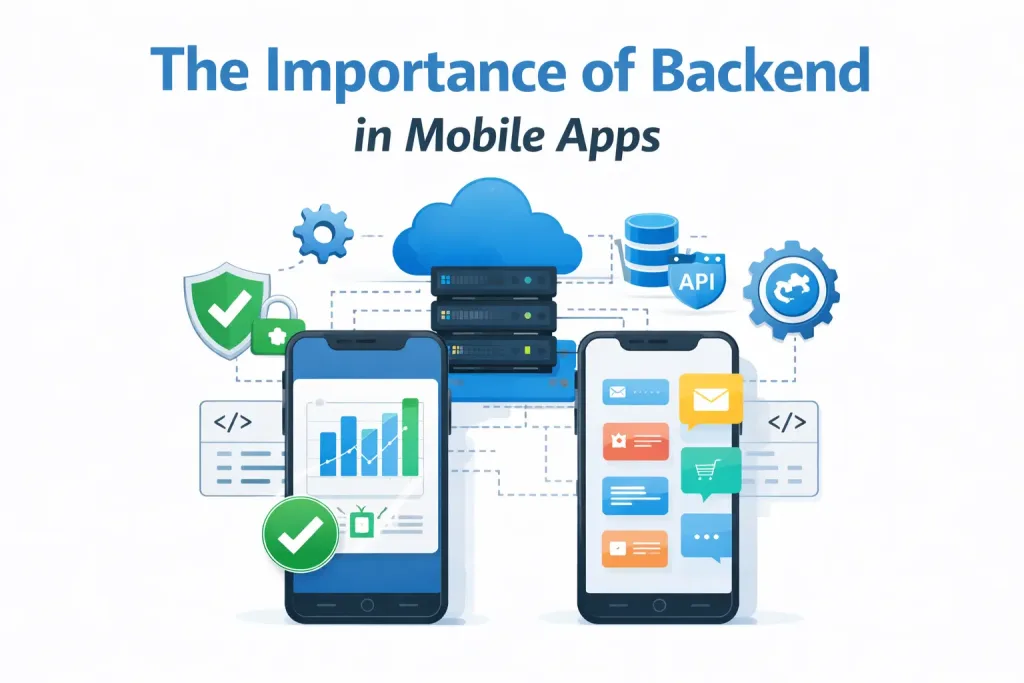


The backend is the hidden part of a mobile app that runs on servers. The Importance of Backend in Mobile Apps lies in handling data storage, user accounts, security, and communication between the app and database. While users see only the interface, the backend powers most core functions, making it essential for smooth app performance.
Why Is Backend Important?
The Importance of Backend in Mobile Apps lies in ensuring smooth performance, secure data handling, and the ability to support many users at once. A strong backend enables features like login, payments, notifications, real-time updates, and data syncing across devices.
APIs: Connecting App and Server
APIs act as a bridge between the mobile app and backend server. When users log in, view content, or make payments, APIs send requests and receive responses. They help the app fetch data, update information, and communicate securely with databases and cloud services. APIs also allow apps to use third-party features such as maps, payment gateways, social logins, and notifications.
Common types include REST and GraphQL APIs, which are widely used in mobile app development because they are fast, flexible, and easy to integrate. Understanding how APIs work is essential for building modern apps that rely on real-time data and online services.
Databases: Where App Data Lives
Databases store user profiles, messages, orders, settings, and more. SQL databases handle structured data, while NoSQL databases are great for flexible and real-time data. Choosing the right database affects app speed and scalability.
Cloud Services in Mobile App Development
Cloud platforms provide ready-made backend infrastructure without managing physical servers. They offer scalability, backups, and global access. Popular options include Firebase, AWS, Google Cloud, and Azure.
Why Backend Matters in Mobile Apps
Apps that work online or involve multiple users require a backend, such as social media, e-commerce, banking, and booking apps. Simple offline tools like calculators or basic note apps may not need one.
Final Summary
The backend is the backbone of modern mobile apps. Understanding APIs, databases, and cloud services helps developers build secure, scalable, and high-performing applications that deliver real value to users. A strong backend is essential in mobile app development, enabling smooth data syncing, user authentication, cloud storage, and reliable performance as apps grow.
1. Why is backend important for mobile apps?
The backend manages data storage, user authentication, business logic, and real-time communication. Without a strong backend, a mobile app cannot securely store information, process requests, or deliver personalized user experiences.
2. What happens if a mobile app has no backend?
An app without a backend can only show static content and cannot support features like login, notifications, payments, or data synchronization. Most modern mobile apps rely on backend servers to function dynamically.
3. Which backend is best for mobile app development?
Popular backends include Node.js, Firebase, Django, Laravel, and .NET. The best choice depends on app requirements such as scalability, real-time features, security, and expected user traffic.
4. How does backend improve mobile app performance?
A well-designed backend optimizes database queries, caching, API responses, and load balancing, which reduces app loading time and ensures smooth performance even with many users.