

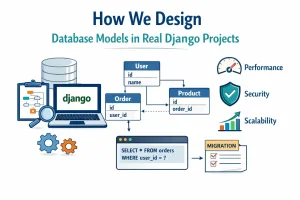

Designing database models is one of the most critical decisions in any Django project. How We Design Database Models in Real Django Projects plays a vital role in shaping application scalability, performance, data integrity, and long-term maintainability. In real-world applications, a well-planned data model enables teams to move faster, scale confidently, and adapt to evolving business requirements without constant restructuring.
Designing Django Database Models with Business Context
In professional Django projects, developers always begin database modeling by deeply understanding the business domain. How We Design Database Models in Real Django Projects emphasizes focusing on real-world entities, workflows, and data relationships rather than immediately considering tables and fields. As a result, the database structure clearly shows how the application operates, not just how it stores data.
Moreover, aligning database models with business logic early allows teams to reduce unnecessary complexity. Consequently, this approach helps teams avoid frequent schema changes later in the development cycle, producing more stable and maintainable Django applications.
Clean and Purpose-Driven Django Database Models
Each Django model is designed with a clear and specific purpose. Keeping models small and focused improves readability, simplifies testing, and makes long-term maintenance easier. Overloaded models often lead to performance issues and tightly coupled code, which can slow down development as the project grows.
Consistency in naming conventions and field definitions also plays a major role in maintaining a clean and professional codebase.
Designing Relationships in Real Django Database Models
Real Django applications rely heavily on well-defined relationships. Choosing the correct relationship type—whether one-to-one, one-to-many, or many-to-many—helps maintain data accuracy and supports efficient querying.
At the same time, database constraints and validations are applied thoughtfully to ensure data integrity without limiting flexibility. This balance helps prevent errors while keeping the system adaptable.
Designing for Scalability and Performance
Scalability is a priority from day one. Database models are structured to support future growth, higher traffic, and expanding features. Indexing frequently queried fields, minimizing unnecessary joins, and optimizing query patterns are all part of the design process.
Rather than relying on later fixes, performance considerations are built directly into the model architecture.
Managing Database Migrations in Real Django Projects
In real projects, database migrations are treated with care. Structural changes are planned, reviewed, and tested before deployment to avoid downtime or data loss. This disciplined approach ensures smooth releases and protects application stability in live environments.
Security and Data Integrity
Professional Django projects require strong data protection. First, developers carefully manage sensitive information at the model level and implement validations and access controls to keep data secure and reliable. Moreover, these practices are crucial when applications handle user data, financial records, or other business-critical information. As a result, teams can ensure compliance, prevent data breaches, and maintain user trust throughout the project lifecycle.
Continuous Improvement and Optimization
Database models are not static. As applications evolve, models are reviewed and refined to match changing requirements and usage patterns. Regular optimization ensures that the database continues to support performance and scalability goals over time.
Conclusion
In real Django projects, database model design is a strategic process that goes beyond technical implementation. First and foremost, by focusing on strong business alignment, a clean structure, scalability, and performance, teams can build database architectures that support long-term success. Moreover, thoughtful model design not only improves overall application efficiency but also enables sustainable growth and easier maintenance. As a result, projects remain flexible, stable, and easier to adapt as requirements evolve over time.