

Introduction
For quite a long time, Java was one of the strongest programming languages in the backend sphere. Nevertheless, the development of backend applications using the conventional Spring was not an easy task. It required the writing of XML configuration files, managing the dependencies manually, and handling the server configurations, among other tasks.
This was the game change introduced in Spring Boot.
Spring Boot made it easier for Java developers to develop the backend by removing the overhead of configuration, which increased productivity and allowed programmers to work more on the business logic and less on the setup. In this blog, we will walk through the functionality of Spring Boot and why it has become the standard for the industry.
First of all, let's start by understanding what Spring Boot means. This will give a clear base for this topic. After that, we will look at its main features and how it simplifies backend application development.
Issues with Conventional Spring Development
Before Spring Boot was invented, backend apps were built with the traditional Spring Framework. They seem powerful but difficult to set up and maintain. Developers faced several common challenges. They are:
1. Heavy XML Configuration
- Projects included large XML files related to bean configuration, data source definition, and security
- Difficult maintainability and error-prone
2. Complex Project Setup
- Managing dependencies manually
- Issues related to the compatibility between libraries
3. External Server Configuration
- Required external servers like Tomcat or JBoss, respectively.
- The process of deployment took longer
4. Boilerplate Code
- Repetitive Configuration/Setup Code Test-Code
- Shorter development cycle
These issues made Java's backend development very powerful but not very developer-friendly.
What Is Spring Boot?
Spring Boot is an extension of the Spring Framework. That helps developers to build production-ready Java applications quickly and with less configuration. It removes most of the manual setup by providing auto-configuration, starter dependencies, and embedded servers.
Using Spring Boot, developers can create standalone, ready-to-run backend applications. By using simple configuration files instead of complex XML. This allows teams to focus more on business logic and features rather than technical setup and infrastructure.
Its main aim is: "Convention Over Configuration"
Provides:
-
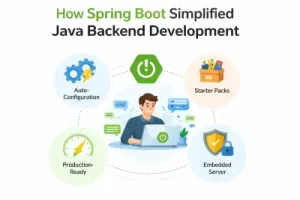
Auto-configuration
-
Embedded servers
-
Starter dependencies
-
Ready-to-use features
All these make it possible for developers to create applications in a short time.
1. Auto-Configuration – Say Goodbye to Manual
Auto-configuration feature is one of the biggest benefits of Spring Boot. It automatically sets up the required settings and components based on the libraries you add to your projects.
So, developers don't need to configure everything manually, which makes development faster and easier.
Spring Boot auto-configuration beans are based on the following:
- List of project dependencies or requisites
- Application properties
- Classpath configuration
Example:
By adding the dependency of spring-boot-starter-data-jpa, the following are:
-
DataSource
-
EntityManager
-
TransactionManager
No XML, no bean definitions by hand.
2. Starter Dependencies: Simplified Dependency Management
Spring Boot brought the concept of "starter dependencies." Starter dependencies are pre-configured dependency groups.
Example Starters:
- spring-boot-starter-web
- spring-boot-starter-data-jpa
- spring-boot-starter-security
- spring-boot-starter-test
Benefit:
- Not necessary to search for each library individually
- Avoids version conflicts
- Cleaner pom.xml
This makes dependency management very simple.
3. Embedded Servers: No More WAR Files
Spring Boot comes with embedded servers like:
-
Tomcat (default)
-
Jetty
-
Undertow
Why it matters:
- No need for WAR files deployment
- Application runs as a standalone JAR
- Increased speed of development and testing
Run your app with:
java -jar myapp.jar
This enables Spring Boot-based applications to be cloud-enabled and microservices-friendly.
4. Minimal Configuration with application.properties
Spring Boot configures the application through the following:
- application.properties
- application.yml
Example:
server.port=8081
spring.datasource.url=jdbc:mysql://localhost:3306/testdb
spring.datasource.username=root
spring.datasource.password=1234
No XML, no multiple config files—just simple key-value configuration.
5. Quick Start with Spring Initializr
Spring Boot provides a web-based tool called Spring Initializr to create projects instantly.
You can:
- Select dependencies
- Choose build tools: Maven/Gradle
- Generate a Runnable Project
This reduces the project setup time from hours to minutes.
6. Simplified REST API Development
Creating REST APIs using Spring Boot is very simple.
Example REST Controller:
@RestController
@RequestMapping("/api")
public class HelloController
- No servlet configuration
- No dispatcher XML
- Built-in JSON support
This makes Spring Boot ideal for RESTful backend services.
7. Production-Ready Features (Actuator)
Spring Boot provides a project called Spring Boot Actuator. It provides the following:
- Health checks
- Metrics
- Application Monitoring
- Environment Details
Example:
management.endpoints.web.exposure.include=health, info
Such characteristics are critical in a real-world manufacturing environment.
8. Easy Integration with Databases and ORM
It seamlessly integrates with:
- JDBC
- JPA
- Hibernate
- MongoDB
With minimal configuration, you can:
- Databases connectivity
- Execute CRUD Operations
- Manage transactions
It cuts backend development time drastically.
9. Microservices and Cloud Readiness
Spring Boot has been developed with the latest trends in application design in mind, such as:
- Microservices
- Network
- Kubernetes
- Cloud platforms
Its lightness and integration with a server make it ideal for use in large-scale backend applications.
Real World Effects of Spring Boot
Real-world effects of Spring Boot is it helps teams to build backend applications faster with less setup and fewer errors. It improves developer productivity and makes deployment ans maintenence easier.
- Improved developer productivity
- Less repetitive code.
- Simplified deployment.
- Better maintainability
Currently, Spring Boot is widely used in:
- Enterprise applications
- Startup products
- Banking and Fintech Solutions
- E-commerce platforms
Conclusion
The emergence of Spring Boot revolutionised the process of developing a Java-based backend by making it:
- Faster
- Simpler
- The more developer-friendly
By reducing complex configurations and offering strong defaults, Spring Boot makes it possible to concentrate on what truly matters: writing business logic.
Being a Java developer, if you are looking to develop a modern-back-end. By using Spring Boot, heavy configurations become a simple application. Spring Boot has become a necessity rather than a choice.