
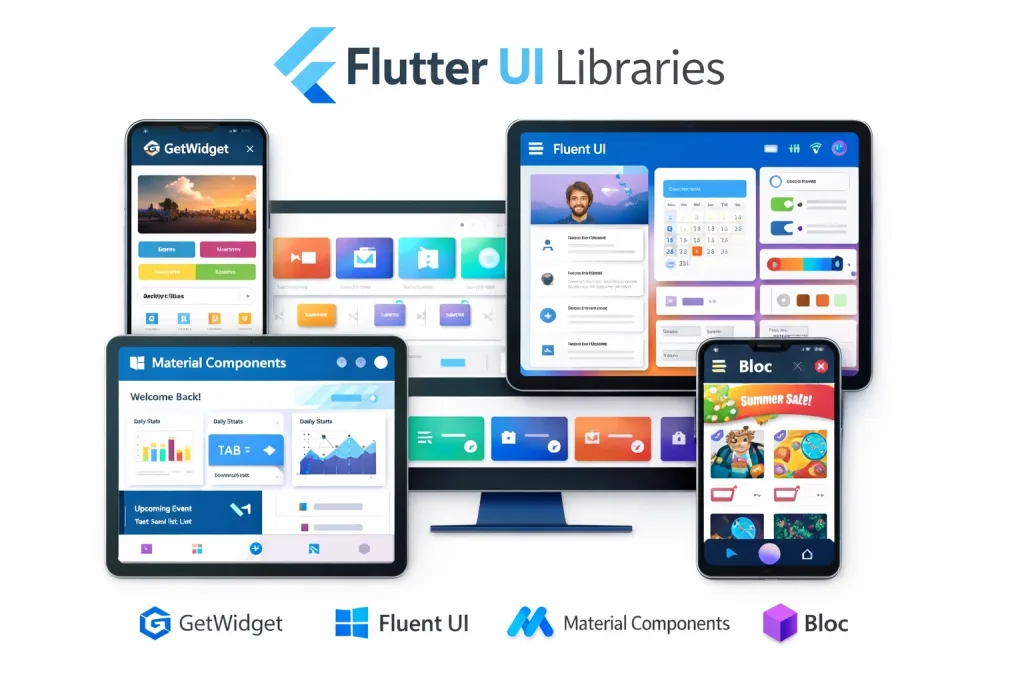


In today’s fast-growing app development environment, speed and quality are critical in any field of technology. Businesses and startups are under pressure to produce applications quickly and should ensure smooth performance and an engaging user experience. Flutter UI libraries play a major role in helping developers to build visually appealing and high-performance mobile applications in less time. By offering pre-designed components and structured design systems, these libraries simplify development also, maintains professional standards.
Ready-Made Components Reduce Development Time
Flutter UI libraries provide pre-built widgets such as buttons, forms, cards, navigation bars, and dialogues. Instead of creating UI elements from scratch, developers can directly integrate these components, significantly reducing coding time and effort. The Flutter team can focus on core functionalities like authentication, API integration, and business logic. This helps to reduce the time spent on styling and layout adjustments. As a result, projects move from development to deployment much faster.
Consistent Design Across the Application
Using a UI library ensures design consistency throughout the app. Colours, typography, spacing, and animations follow a unified style, resulting in a professional and polished user interface without repetitive styling work. When every element follows a structured design system, the application looks more professional and polished. This consistency improves user trust and enhances brand identity. It helps to eliminate repetitive styling work. As developers rely on predefined design tokens and themes.
Faster Prototyping and MVP Development
UI libraries are especially useful for startups and product teams building MVPs. Developers can quickly assemble screens, test user flows, and make improvements without spending weeks on UI design.
This allows teams to validate their ideas faster and grab real user feedback at an early stage. By reducing design time, businesses can focus more on refining core features and achieving a quicker time-to-market.
Simplified Maintenance and Scalability
With reusable components, updating the UI becomes easier. Changes made in one place automatically reflect across the app, making future enhancements and maintenance more efficient. This removes redundancy and prevents inconsistencies.
It also helps development teams to maintain an organised codebase over time. As the application creation progresses, new features can be added smoothly without disrupting the existing design structure.
Built-In Responsiveness and Platform Support
Modern applications must function smoothly across various devices and screen sizes. Many Flutter UI are designed to adapt seamlessly across screen sizes and platforms. They support both Material (Android) and Cupertino (iOS) styles, ensuring a native look and feel on all devices. This cross-platform efficiency saves time and ensures a consistent user experience.
Improved Developer Productivity
Clean, well-documented UI libraries reduce boilerplate code and simplify widget structures. This allows developers to focus more on business logic and app functionality rather than UI complexities. By minimising repetitive tasks, developers can concentrate more on implementing advanced features,
Community Support and Continuous Updates
Popular Flutter UI libraries are actively maintained by large communities. Regular updates, bug fixes, and new components help developers stay aligned with the latest Flutter standards.
Community support also provides documentation, tutorials, and discussion forums that make problem-solving easier. This continous improvement ensures better stability, and long term and long term reliability for applications.
Why Flutter UI Libraries Matter in 2026
With increasing demand for faster app releases and high-quality user experiences, Flutter UI libraries have become essential tools. They help teams deliver scalable, visually consistent, and performance-optimised apps in competitive timelines.
By streamlining design and development workflows, these libraries reduce overall project complexity and improve team collaboration. As competition in the mobile app market continues to grow, leveraging efficient UI solutions gives businesses a strong advantage in delivering impactful digital products.
Conclusion
Flutter UI libraries are not just about aesthetics; they are productivity boosters. They simplify design implementation, improve consistency, enhance scalability and accelerate development cycles. By using the right UI libraries, developers can accelerate development, maintain design consistency, and build professional mobile applications efficiently.